CARTHAGINENSIA (ISSN 0213-4381 E-ISSN 2605-3012), published every six months (January and July of each year), was founded in 1985 as an organ of cultural and scientific expression of the Theological Institute of Murcia O.F.M., a Center attached to the Faculty of Theology of the Pontifical University Antonianum (Rome). The content of the Journal covers the various areas of knowledge taught in this Center: Theology, Philosophy, Ecclesiastical and Franciscan History of Spain and America, Franciscanism, humanism and Christian thought, and current issues in the field of ecumenism, ethics, morality, law, anthropology, etc.
Vol. 42 No. 82 (2026): Religion, Politics, Economy: Catholics and Reformers in the Making of Modern Europe
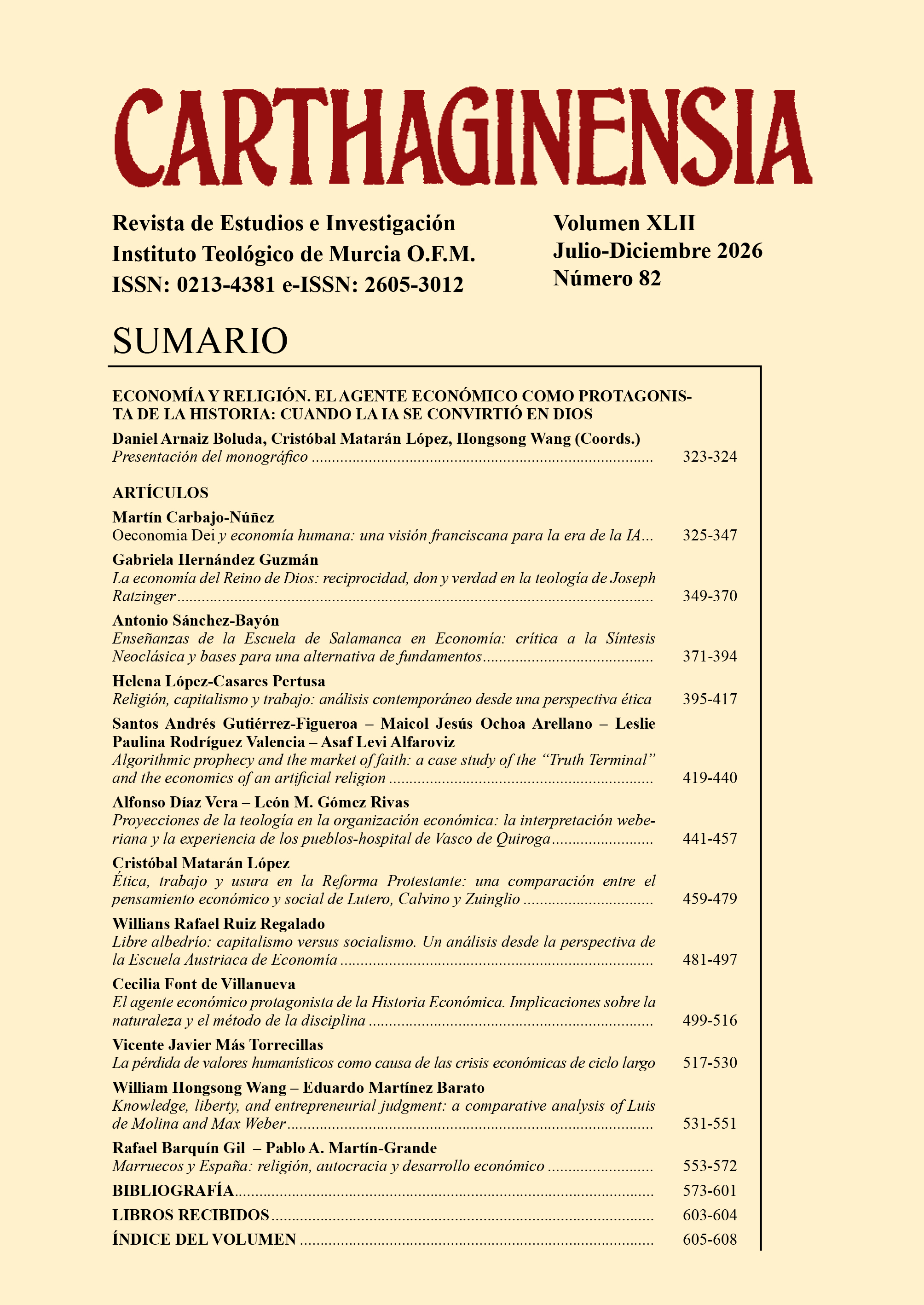
This special issue of Carthaginensia, entitled “The Economic Agent as the Protagonist of History: When Artificial Intelligence Became God,” emerges at a time of profound technological transformation. In a context in which artificial intelligence (AI) not only optimizes processes but also begins to generate its own narratives and systems of belief, this editorial project seeks to restore the economic agent as the true protagonist of history, recovering the ethical and transcendent dimensions of human action in the face of contemporary reductionist approaches.
This special issue is presented as a corrective to the denaturalization of economics, advocating instead for a science grounded in human responsibility. Through the contributions gathered in this volume, it is argued that economic problems ultimately arise from the neglect of the values that constitute the human person.
The human being is not merely an isolated individual driven exclusively by calculations of cost and benefit. Rather, this volume presents the human person as a relational, free, and responsible agent endowed with genuine creative capacity—a capacity that ought to be recognized as the true driving force of economic life.
Published:
2026-07-01
View All Issues
eISSN 2605-3012 ISSN 0213-4381 Biannual Review of Theology and Humanities / Peer Review
CARTHAGINENSIA was founded in 1985 as an organ of cultural and scientific expression of the Theological Institute of Murcia O.F.M., a Center attached to the Faculty of Theology of the Pontifical University Antonianum (Rome). The content of the Journal covers the various areas of knowledge taught at this Center: Theology, Philosophy, Humanities, humanism and Christian thought, and current issues in the field of ecumenism, ethics, morals, law, anthropology.