
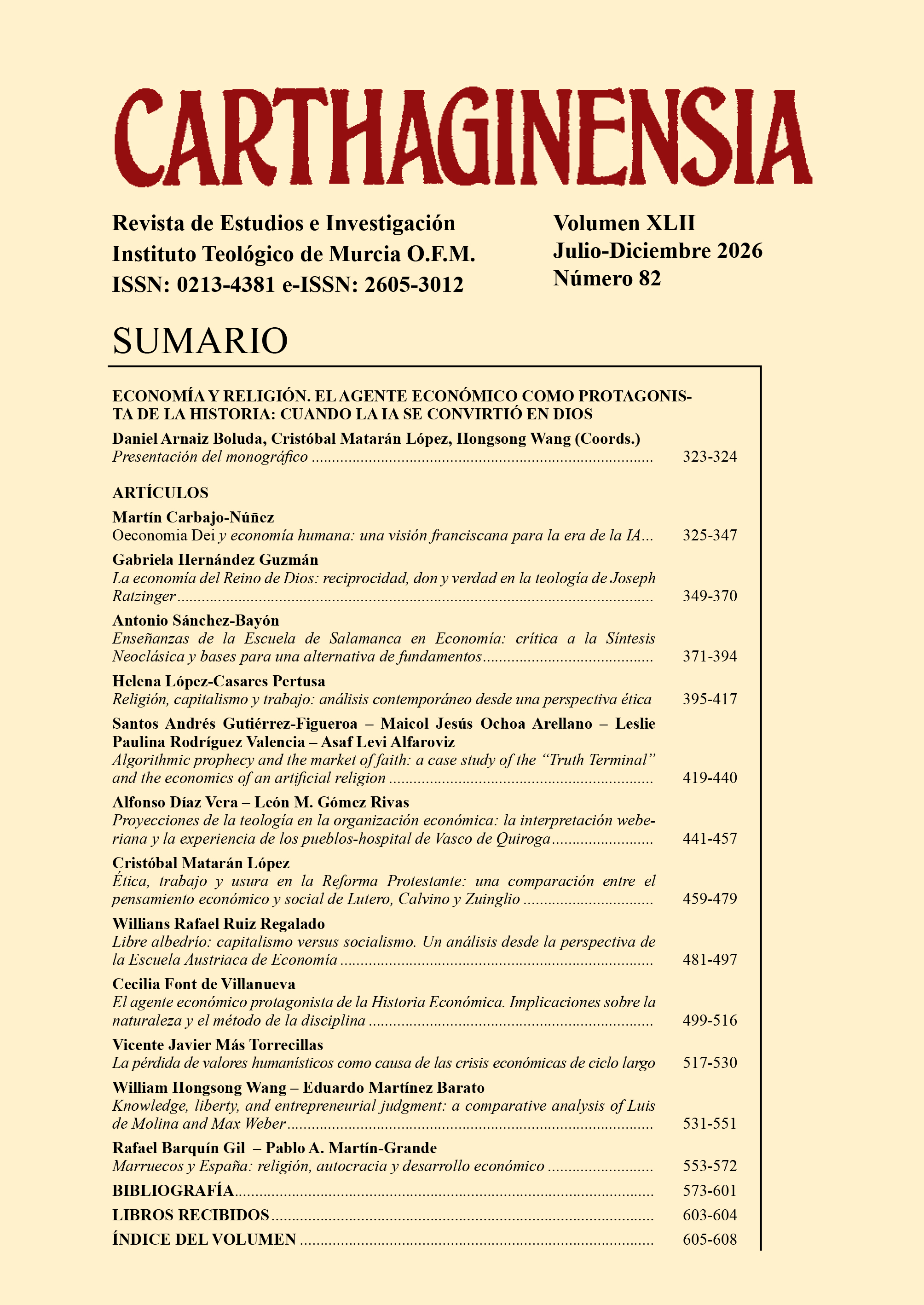
Free Will: Capitalism versus Socialism. An Analysis from the perspective of the Austrian School of Economics.
Article Sidebar
Main Article Content
Abstract
This article examines free will as a central anthropological and moral category in the Catholic tradition—developed particularly by St Augustine and St Thomas Aquinas, and reaffirmed by the contemporary Magisterium—and establishes a critical dialogue with the notion of freedom characteristic of the Austrian School of Economics (Mises, Hayek, Rothbard, Huerta de Soto, Kirzner). The objective is to comparatively assess the congruence between free will and two ideal-typical institutional orders: market capitalism and coercive planning socialism. It is argued that, to the extent that free will requires a real sphere of choice and responsibility, institutional orders that minimise coercion and preserve personal initiative—particularly those that protect private property, contractual freedom, and the principle of subsidiarity—are more consistent with a Christian anthropology of freedom than those that systematically replace individual decision-making with central direction. Far from sacralising the market, it is argued that capitalism is only morally defensible when subordinated to the rule of law and an ethical culture; nevertheless, under anthropological and moral criteria, it offers more favourable conditions for the ordinary exercise of free will than socialism in its forms of coercive planning.
Downloads
Publication Facts
Reviewer profiles N/A
Author statements
- Editor & editorial board
- profiles
- Academic society
- Instituto Teológico de Murcia OFM
- Publisher
- Instituto Teológico de Murcia OFM

To learn about these publication facts, click 
PF is maintained by the Public Knowledge Project
Global Statistics ℹ️
|
681
Views
|
89
Downloads
|
|
770
Total
|
|
Article Details

This work is licensed under a Creative Commons Attribution 3.0 Unported License.
The works published in this journal are subject to the following terms:
1. Carthaginensia retains the patrimonial rights (copyright) of the published works, and favors and allows the reuse of the same under the license of use indicated in the following point.
2. The works are published in the electronic edition of the journal under a Creative Commons By (CC By) License https://creativecommons.org/licenses/by/3.0/es/. They may be copied, used, disseminated, transmitted and publicly exhibited, provided that: i) the authorship and the original source of publication (journal, publisher and URL of the work) are cited; ii) they are not used for commercial purposes; iii) the existence and specifications of this license of use are mentioned.




References
Hipona, Agustín. De libero arbitrio. Madrid: Biblioteca de Autores Cristianos, 2009.
Aquino, Tomás. Suma Teológica. Edición de la Biblioteca de Autores Cristianos. Madrid: BAC, 2014.
Catecismo de la Iglesia Católica. Ciudad del Vaticano: Librería Editrice Vaticana, 1997.
Duque, J. «Catolicismo, modernidade e pós-modernidade», Carthaginensia, 73 (2025), pp. 129–142. doi: 10.62217/carth.334. DOI: https://doi.org/10.62217/carth.334
Hayek, Friedrich A. Camino de servidumbre. Madrid: Alianza Editorial, 2008.
Huerta de Soto, Jesús. Socialismo, cálculo económico y función empresarial. 7.ª ed. Madrid: Unión Editorial, 2024.
Kirzner, Israel M. Competencia y empresarialidad, 3.ª ed. Madrid: Unión Editorial, 2020.
Juan Pablo II. Centesimus Annus. Ciudad del Vaticano: Librería Editrice Vaticana, 1991.
Menger, Carl. El método de las ciencias sociales. Madrid: Unión Editorial, 2006.
Meseguer, Cesar. Teoría evolutiva de las instituciones. Madrid: Unión Editorial, 2009.
Mises, Ludwig von. El socialismo. Análisis económico y sociológico. 8.ª ed. Madrid: Unión Editorial, 2019.
Mises, Ludwig von. La acción humana. Tratado de economía. 16.ª ed. Madrid: Unión Editorial, 2024.
Rothbard, Murray N. La ética de la libertad. 3.ª ed. Madrid: Unión Editorial, 2020.
Zanotti, Gabriel. Economía de mercado y doctrina social de la iglesia. Buenos Aires: Belgrano, 1985.
Zanotti, Gabriel. Antropología filosófica cristiana y economía de mercado. Madrid: Unión Editorial, 2011.