
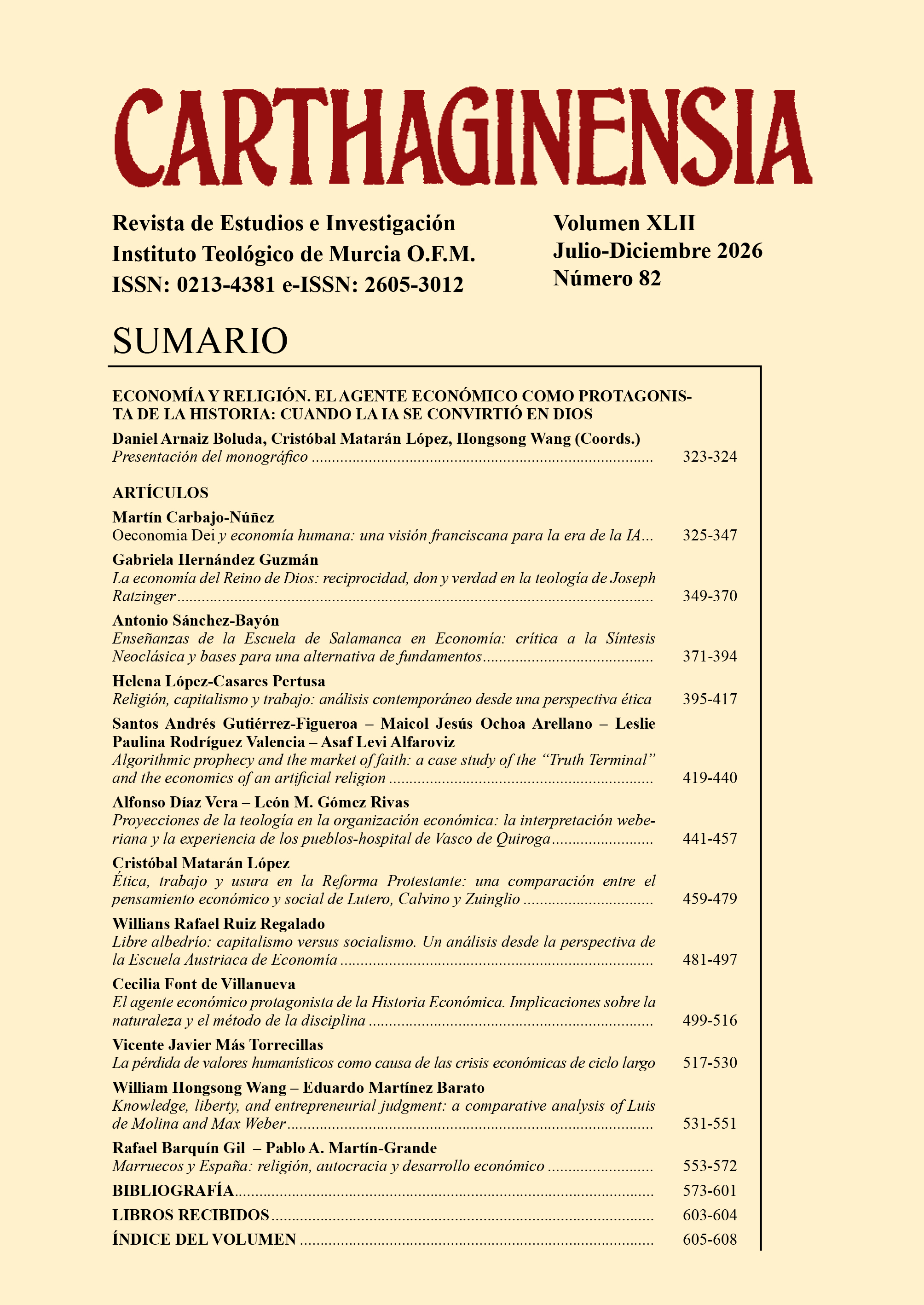
Lessons of Salamanca School in economics: critique of neoclassical synthesis and foundations for a mainline alternative
Article Sidebar
Main Article Content
Abstract
This study reviews the educational foundations of Economics, questioning the origins and developments established by the mainstream view of the Neoclassical Synthesis and offering an alternative, based on the lessons from Salamanca School, which also serves as a connecting thread to heterodox approaches. First, it clarifies the main conceptual and methodological errors of the Neoclassical Synthesis and its anti-economic normative trap (which have caused the current crisis in Economics and its study). Then, it presents and explains the key aspects from Salamanca School as an alternative to this deviation. Finally, it offers a synthesis of Salamanca School and its influence on other schools, now considered heterodox and alternatives to the educational monopoly of the Neoclassical Synthesis. As a result of this review, it will then be understood why Salamanca School turned out to be the first modern economic school, allowing the West to move from moral to positive economics, but without falling into normative economics and its distortions.
Downloads
Publication Facts
Reviewer profiles N/A
Author statements
- Editor & editorial board
- profiles
- Academic society
- Instituto Teológico de Murcia OFM
- Publisher
- Instituto Teológico de Murcia OFM

To learn about these publication facts, click 
PF is maintained by the Public Knowledge Project
Global Statistics ℹ️
|
592
Views
|
111
Downloads
|
|
703
Total
|
|
Article Details

This work is licensed under a Creative Commons Attribution 3.0 Unported License.
The works published in this journal are subject to the following terms:
1. Carthaginensia retains the patrimonial rights (copyright) of the published works, and favors and allows the reuse of the same under the license of use indicated in the following point.
2. The works are published in the electronic edition of the journal under a Creative Commons By (CC By) License https://creativecommons.org/licenses/by/3.0/es/. They may be copied, used, disseminated, transmitted and publicly exhibited, provided that: i) the authorship and the original source of publication (journal, publisher and URL of the work) are cited; ii) they are not used for commercial purposes; iii) the existence and specifications of this license of use are mentioned.




References
Alcorn, Stanley & B. Solarz. “The autistic economist”. Post-Autistic Economics Review, 38: 13-19. 2006
Aullón de Haro, Pedro. "Fenomenografía de la Escuela Universalista". En Id. (ed.) Idea de la Ilustración: Estudios sobre la Escuela Universalista, Madrid, Verbum, 2022, pp. 19-88
Bagus, Phillip, F. Daumann y F. Follert. “Cancel Culture, Safe Spaces, and Academic Freedom: A Private Property Rights Perspective”. SSRN Electronic Journal, 2022. https://doi.org/10.2139/ssrn.4153396. DOI: https://doi.org/10.2139/ssrn.4153396
Ballvé, Faustino. Los fundamentos de la Ciencia Económica. Unión Editorial. Madrid. 2012[1956].
Baltzell, Edward D. The Protestant Establishment. Aristocracy & Caste in America. Random House. New York. 1964.
Baltzell, Edward D. An American Business Aristocracy. Collier Books. Philadelphia. 1962.
Barrera-Escobar. Alejandro. “Antagonismo y complementariedad de la ortodoxia y heterodoxia: desde Smith hasta Keynes”. Lúmina 26(1). 2025. https://doi.org/10.30554/lumina.v26.n1.5078.2025 DOI: https://doi.org/10.30554/lumina.v26.n1.5078.2025
Belda, Juan. “¿Qué es la Escuela de Salamanca? Nuevas perspectivas”. Araucaria. Revista Iberoamericana de Filosofía, Política, Humanidades y Relaciones Internacionales, 25(54): 391-415. 2023. https://dx.doi.org/10.12795/araucaria.2023.i54.20 2023. DOI: https://doi.org/10.12795/araucaria.2023.i54.20
Bernanke, Ben, The Great Recession, FED. Kansas City. 2004.
Boettke, Peter y P. Leeson. “Postwar Heterodox Economics: The Austrian School of Economics: 1950–2000”. En Warren Samuels, J. BiddleJohn y B. Davis (eds.). A companion to the history of economic thought, Blackwell Publishing Ltd, New York, 2003. p. 445-453. DOI: https://doi.org/10.1111/b.9780631225737.2003.00029.x
Boettke, Peter, S. Haeffele-Balch y V. Storr. Mainline Economics. George Mason University. 2016.
Castaño, José. “Discusión francesa sobre la enseñanza de la economía”. Cuadernos de Economía, 20(35): 287-296. 2001.
Cox, Oliver. The foundations of capitalism. Philosophical Library. New York. 1959
Elzinga, Kenneth. "The Eleven Principles of Economics," Southern Economic Journal, 58(4): 861-79, 1992 DOI: https://doi.org/10.2307/1060226
Fernández de Navarrete, Martín. Biblioteca Marítima Española. Imprenta de la viuda de Calero. Madrid. 1851.
d’Abrera, Bella. “Get woke go broke”. Institute for Public Affairs Review, 71, 20–31. 2019
de Arteche, José. Urdaneta, El dominador de los espacios del Océano Pacífico. Espasa-Calpe. Madrid. 1943
de Mariana, Juan. De monetae mutatione. Ed. privada. Toledo. 1605 (ed. revisada en 1609 para ser liberado).
de Mariana, Juan. Historia general de España. Ed. priv. Toledo. 1601.
de Mariana, Juan. De rege et regis institutione. Ed. priv. Toledo. 1599.
de Mariana, Juan. Historia de rebus Hispaniae. Ed. priv. Toledo. 1592.
Hayek, Friedrich v. The fatal conceit. Univ. Chicago Press. Chicago. 1988. DOI: https://doi.org/10.7208/chicago/9780226321158.001.0001
Hayek, Friedrich v. The Road to Serfdom. Roudledge. London. 1944.
Hayek, Friedrich v. Prices and production. Roudledge. London. 1931.
Heidegger, Martin. Nietzsche (v. I-II). Klett-Cotta, Stuttgart. 1980.
Hicks, John. "Mr. Keynes and the “Classics”; A Suggested Interpretation," Econometrica, 5(2), pp. 147–159. 1937. https://www.jstor.org/stable/1907242 DOI: https://doi.org/10.2307/1907242
Huerta de Soto, Jesús, A. Sánchez-Bayón, & P. Bagus (2025). “Dispute on Efficiency and Sustainability with COVID Crisis: Bureaucratic Government Coaction vs Spontaneous and Flexible Social Coordination”. Highlights of Sustainability, 4(4), 205–215, 2025. https://doi.org/10.54175/hsustain4040013 DOI: https://doi.org/10.54175/hsustain4040013
Huerta de Soto, Jesús. “Juan de Mariana y los escolásticos españoles”. Dendra Médica Rev. Humanidades, 12(1), 32-45. 2013.
Huerta de Soto, Jesús. The theory of dynamic efficiency. Routledge. London. 2009
Huerta de Soto, Jesús. Socialismo, cálculo económico y función empresarial. Unión Editorial. Madrid. 1992.
Krugman, Paul. The conscience of a liberal. The New York Times. New York. 2009.
Kuhn, Thomas. The Copernican Revolution. Harvard Univ. Press. Cambridge. 1957. - The Structure of Scientific Revolutions. Univ. Chicago Press. Chicago. 1962.
Lakatos, Imre. The methodology of scientific research programmes. Cambridge Univ. Press. Cambridge. 1978. DOI: https://doi.org/10.1017/CBO9780511621123
Lilla, Mark. The Reckless Mind: Intellectuals and Politics. Review Books. New York. 2016 DOI: https://doi.org/10.2307/j.ctvpj77nd.15
Lucas, Robert. “Econometric Policy Evaluation: A Critique”. Carnegie-Rochester Conference Series on Public Policy, 1: 19-46. 1976. DOI: https://doi.org/10.1016/S0167-2231(76)80003-6
Mankiw, Gregory N. "The Macroeconomist as Scientist and Engineer". The Journal of Economic Perspectives, 20(4): 29-46. 2006. DOI: 10.1257/jep.20.4.29 DOI: https://doi.org/10.1257/jep.20.4.29
Martín de la Hoz, José Carlos y León Gómez. La Escuela de Salamanca. Cuando el pensamiento español iluminó el mundo. Sekotia. Córdoba. 2025.
Marx, Karl. Der 18te Brumaire des Louis FILIPH Napoleon. New York: Weydemeyer. 1852
Menger, Carl. Grundsätze der Volkswirtschaftslehre. Wien: Braumüller.1871
Mises, Ludwig v. Human Action: A Treatise on Economics. Yale University Press. New Haven. 1949.
Nietzsche, Friedrich. Zur Genealogie der Moral. Verlag. Leipzig.
PAE. Post-autistic economics newsletter. 2000 (Issue No. 3 of the Post-Autistic Economics Newsletter (paecon.net)).
Pérez, Elviro. Catálogo bio-bibliográfico de los religiosos agustinos de la provincia del Santísimo Nombre de Jesús de las Islas Filipinas desde su fundación hasta nuestros días. Manila. 1901.
Romer, Paul. The Trouble With Macroeconomics. New Haven: Yale University. 2016.
Romer, Paul. “Mathiness in the theory of economic growth”. American Economic Review, 105(5): 89-93. 2015.
DOI:10.1257/aer.p20151066. DOI: https://doi.org/10.1257/aer.p20151066
Röpke, Wilhelm. Jenseits von Angebot und Nachfrage. Erlenbach. Verlag. Zürich. 1958
Ruíz de Santayana, Jorge A.N. The life of reason, New York : Scribner's Sons, 1905-06 Jorge A.N. Ruíz de Santayana, The life of reason, New York : Scribner's Sons, 1905-06
Samuelson, Paul A. Economics: An introductory analysis. McGraw-Hill. New York. 1948 (2º ed. 1951).
Sánchez-Bayón, Antonio. “Revisión de las relaciones ortodoxia-heterodoxia en la Economía y la transición digital”. Pensamiento, 81(314): 523-550. 2025. https://doi.org/10.14422/pen.v81.i314.y2025.012. DOI: https://doi.org/10.14422/pen.v81.i314.y2025.012
Sánchez-Bayón, Antonio. “Ortodoxia versus heterodoxias sobre la colonización del Oeste estadounidense por empresas religiosas e ideológicas”. Carthaginensia, 40(77): 117-156. 2024. https://doi.org/10.62217/carth.457.
Sánchez-Bayón, Antonio. “Acervo económico de la Escuela de Salamanca: reconocimiento y relación con otras escuelas”. Estudios económicos, 41(83): 5-32. 2024. https://doi.org/10.52292/j.estudecon.2024.3441 DOI: https://doi.org/10.52292/j.estudecon.2024.3441
Sánchez-Bayón, Antonio. «Ortodoxia Versus Heterodoxia Sobre La colonización Del Oeste Estadounidense Por Empresas Religiosas E ideológicas: ». Carthaginensia 77 (2024):117-56. https://doi.org/10.62217/carth.457. DOI: https://doi.org/10.62217/carth.457
Sánchez-Bayón, Antonio. “Renovación de la Teología política y Sociología de la religión en la posglobalización”. Carthaginensia. 35(68): 485-510. 2019. https://hdl.handle.net/10115/32205
Sánchez-Bayón, Antonio. “Estudio de la idiosincrasia estadounidense desde su Teología política y Ciencias Eclesiásticas”. Estudios Eclesiásticos, 93(364): 165-204. 2018.
Sánchez-Bayón, Antonio. “Revelaciones conceptuales y lingüísticas de la posglobalización”. Carthaginensia, 33(64), 411-458. 2017.
Schumpeter, Joseph A. History of Economic Analysis (ed. Elizabeth Boody Schumpeter). Oxford University Press. New York. 1954.
Skousen, Mark. Economics on trial. Homewood. Irwin. 1991.
Skousen, Mark. “The Perseverance of Paul Samuelson's Economics Author(s)”. The Journal of Economic Perspectives, 11(2): 137-152. 1997. DOI: https://doi.org/10.1257/jep.11.2.137
Smith, Adam. An Inquiry into the Nature and Causes of the Wealth of Nations. W. Strahan & T. Cadell. London. 1776 DOI: https://doi.org/10.1093/oseo/instance.00043218
Sowell, Thomas. Social Justice Fallacies. Hachette Book Group. New York. 2023.
Sowell, Thomas. Economic facts and fallacies. Basic Books. New York. 2015.
Tawney, Richard. Religion and the Rise of Capitalism. J. Murray. London. 1926.
Valero, Jesús y A. Sánchez-Bayón. Balance de la globalización y teoría social de la posglobalización. Dykinson. Madrid. 2018
Zanotti, Gabriel. Introducción a la Escuela Austriaca de Economía. Unión Editorial. Madrid. 2012