
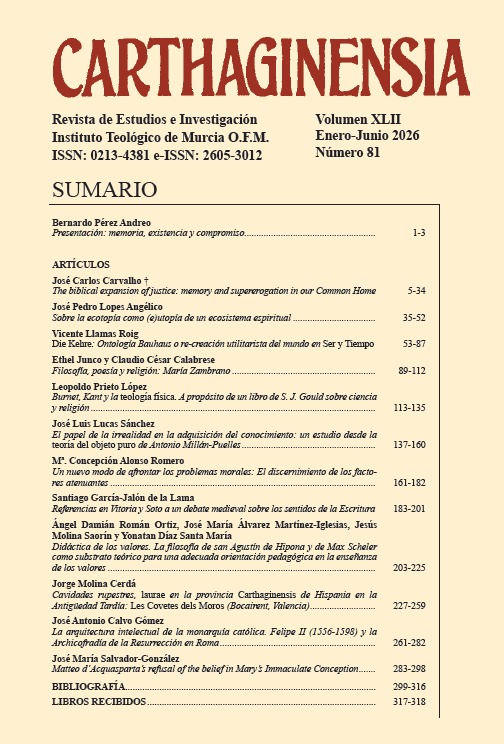
Die Kehre: Bauhaus Ontology or Utilitarian Recreation of the World in Being and Time
Article Sidebar
Main Article Content
Abstract
«Form follows function» or «The ultimate goal of all (artistic) activity is construction» are principles of design declared by the Staatliches Bauhaus in its founding manifesto of 1919, syncretic theses to basal proposals in Being and Time (1927): «Being-ready-to-hand», utilitarian disposition of the intramundane entity that Dasein faces in the Care as an occupying projection (Besorge) is a pre-formal ontological dimension placed before the condition of «Being-present-at-hand» and the work in its integral magnitude encompasses the plexus of functional references in which aforementioned entity originally appears as useful (also the «comprehensive artwork» advocated by the School is a synthetic unity of references). Being emerges in its use, and use translates a peculiar form of pre-theoretical gaze that is decisive in the praxis of Dasein: minimalism in geometric layouts (Heidegger's notion of Quadrature: a bundle of presences and absences in the historical horizon of the inchoative truth for the analysis of the static-horizontal unity prior to any projection of Existenz) versus curvilinear plots, Nature contracted to potential materials of use that reveal the true essence of objects in constant development. The creational scenario of onto-theology becomes a functional domain in a utilitarian ontology in which «Being-in-itself» is sustained in the mundane void by a radical depragmatization that conceals the drift toward a destiny originating from Being.
Downloads
Publication Facts
Reviewer profiles N/A
Author statements
- Editor & editorial board
- profiles
- Academic society
- Instituto Teológico de Murcia OFM
- Publisher
- Instituto Teológico de Murcia OFM

To learn about these publication facts, click 
PF is maintained by the Public Knowledge Project
Global Statistics ℹ️
|
1104
Views
|
275
Downloads
|
|
1379
Total
|
|
Article Details

This work is licensed under a Creative Commons Attribution 3.0 Unported License.
The works published in this journal are subject to the following terms:
1. Carthaginensia retains the patrimonial rights (copyright) of the published works, and favors and allows the reuse of the same under the license of use indicated in the following point.
2. The works are published in the electronic edition of the journal under a Creative Commons By (CC By) License https://creativecommons.org/licenses/by/3.0/es/. They may be copied, used, disseminated, transmitted and publicly exhibited, provided that: i) the authorship and the original source of publication (journal, publisher and URL of the work) are cited; ii) they are not used for commercial purposes; iii) the existence and specifications of this license of use are mentioned.




References
Aristóteles. Ética Nicomáquea. Madrid: Centro de Estudios Políticos y Constitucionales, 1999.
Derrida, Jacques. De l'esprit. Heidegger et la question. Paris: Galilée, 1987.
Gadamer, Hans-Georg. «Die phänomenologische Bewegung». Philosophische Rundschau 11 / 1 (1963): 1-45.
Heidegger, Martin. Die Grundprobleme der Phänomenologie, Gesamtausgabe (GA) 24. Frankfurt am Main: Vittorio Klostermann, 1975.
Heidegger, Martin. «Brief über den Humanismus». En Wegmarken, 313-364, GA 9. Frankfurt am Main: Klostermann, 1976. DOI: https://doi.org/10.5771/9783465141839-313
Heidegger, Martin. Logik. Die Frage nach der Wahrheit, GA 21. Frankfurt am Main: Klostermann, 1976.
Heidegger, Martin. Sein und Zeit, GA 2, Frankfurt am Main: Klostermann, 1977.
Heidegger, Martin. Kant und das Problem der Metaphysik, GA 3. Frankfurt am Main: Klostermann, 1991.
Heidegger, Martin. Ser y Tiempo. Santiago de Chile: Editorial Universitaria, 1997.
Heidegger, Martin. Vörtrage und Aufsätze. Stuttgart: Klett-Cotta, 2004 [GA 7, Frankfurt am Main: Klostermann, 2000].
Herrmann, Friedrich-Wilhelm von. Subjekt und Dasein. Interpretationen zu «Sein und Zeit». Frankfurt am Main: Vittorio Klostermann, 1974.
Husserl, Edmund. Ideas relativas a una fenomenología pura y una filosofía fenomenológica. México: Fondo de Cultura Económica, 1949.
Llamas Roig, Vicente. «La diáspora anti-metafísica: epígonos del νοούμενον y fisionomía del Terror». Carthaginensia 76 (2024). doi https://doi.org/10.62217/carth.558. DOI: https://doi.org/10.62217/carth.558
Llamas Roig, Vicente. «Ocaso de la metafísica. Epifanía del Eikon», Carthaginensia, 75 (2024). doi: 10.62217/carth.485. DOI: https://doi.org/10.62217/carth.485
Mitchell, Andrew. The Fourhold: Reading the late Heidegger. Evanston (Illinois): Northwestern University Press, 2015. DOI: https://doi.org/10.2307/j.ctv43vtf4
Perle, Georg. Serial Composition and Atonality: An Introduction to the Music of Schoenberg, Berg, and Webern. Berkeley: University of California Press, 1977.
Pöggeler, Otto. «Heideggers Neubestimmung des Phänomenbegriffs». Phänomenologische Forschungen 9 (1980): 124-162.
Pöggeler, Otto. «Zeit und Sein bei Heidegger». En Zeit und Zeitlichkeit bei Husserl und Heidegger. Phänomenologische Forschungen 14 (1983): 152-191.
Tugendhat, Ernst. Der Wahrheitsbegriff bei Husserl und Heidegger. Berlin: De Gruyter, 1967. DOI: https://doi.org/10.1515/9783111523071