
Oeconomia Dei y economía humana: Una visión franciscana para la era de la IA
Barra lateral del artículo
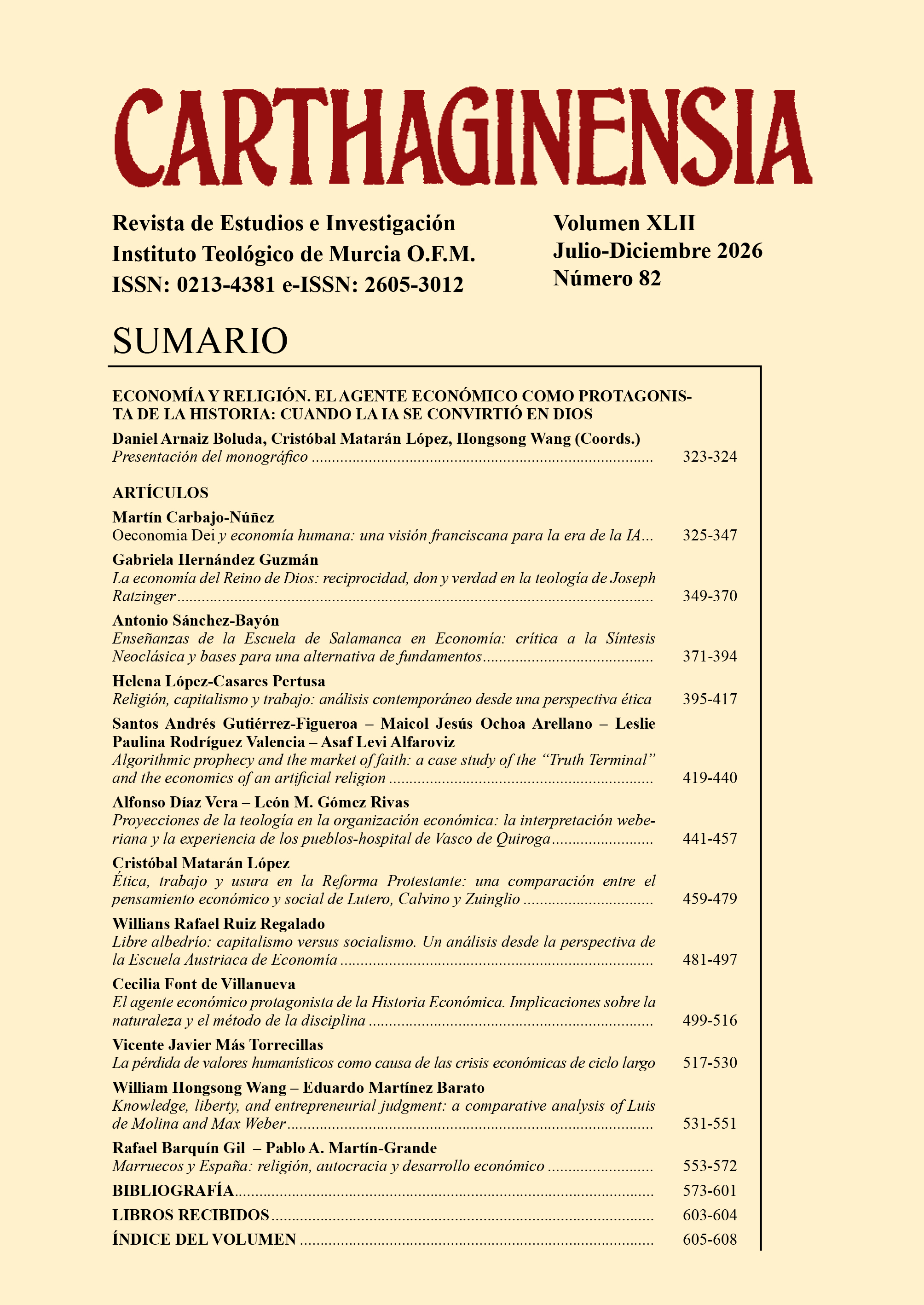
Contenido principal del artículo
Resumen
Este artículo presenta la notable contribución de los franciscanos a la humanización y el desarrollo de la incipiente economía de mercado entre los siglos XIII y XV. La primera parte explora cómo Francisco de Asís respondió proféticamente a esos retos renunciando al dinero y abrazando la lógica de la gratuidad. A partir de sus intuiciones, los franciscanos articularon posteriormente los fundamentos teológicos de la relación entre la oeconomia Dei y la economía humana (segunda parte). Sobre esta base, desarrollaron un pensamiento económico innovador que algunos estudiosos han descrito como la «primera escuela económica de la que surgiría el moderno espíritu de mercado» (tercera parte). Esas respuestas de ayer pueden ayudar hoy a afrontar los retos socioeconómicos derivados de la creciente influencia de la inteligencia artificial (cuarta parte).
Descargas
Publication Facts
Reviewer profiles N/D
Author statements
- Editor & editorial board
- profiles
- Academic society
- Instituto Teológico de Murcia OFM
- Editora:
- Instituto Teológico de Murcia OFM

Para obtener más información sobre un dato, haga clic

PF is maintained by the Public Knowledge Project
Estadísticas globales ℹ️
|
1373
Visualizaciones
|
150
Descargas
|
|
1523
Total
|
|
Detalles del artículo

Esta obra está bajo una licencia Creative Commons Reconocimiento 3.0 Unported.
Las obras que se publican en esta revista están sujetas a los siguientes términos:
1. Carthaginensia conserva los derechos patrimoniales (copyright) de las obras publicadas, y favorece y permite la reutilización de las mismas bajo la licencia de uso indicada en el punto siguiente.
2. Las obras se publican en la edición electrónica de la revista bajo una Licencia de uso Creative Commons By (CC By) https://creativecommons.




Citas
Brecht, Bertolt. La buena persona de Sezuán (Der gute Mensch von Sezuan). Madrid: Alfil, 1968, 15.
Bernardino de Siena. «Sermo XXXIII. De mercationibus et vitiis mercatorum». En Opera omnia, vol. 4.
Bernardino de Siena. Opera omnia. Ad Claras Aquas, Florentiae, 1950–1965.
Bernardino de Siena. Prediche volgari sul campo di Siena. Rusconi, Milano, 1989.
Bruni, Luigino. «Las raíces franciscanas de la economía de mercado y de la “Caritas in veritate”. Ambivalencias y posibilidades». Scripta Theologica 44 (2012): 148. DOI: https://doi.org/10.15581/006.44.1445
Bruni, Luigino. «Y la libre pobreza franciscana dio verdadero valor al dinero». Avvenire, 6.12.2020. https://www.avvenire.it/idee-e-commenti/e-la-libera-poverta-francescana-diede-vero-valore-al-denaro_48391.
Capitani, Ovidio. «San Bernardino e l’etica economica». En ID. (ed.), Una economia politica nel medioevo. Bologna: Pàtron, 1987, 121–141.
Carbajo-Núñez, Martín. Crisis económica. Una propuesta franciscana, = Estudios y Ensayos, BAC, Madrid 2013.
Carbajo Núñez, Martín. «Artificial Intelligence: Possibilities and Challenges Franciscan Humanism of Fraternity». Carthaginensia 80 (2025):767-88. https://doi.org/10.62217/carth.622. DOI: https://doi.org/10.62217/carth.622
Carbajo Núñez, Martín. «La economía del nosotros: una perspectiva franciscana». Selecciones de Franciscanismo 144/L (2021): 295–314.
Carbajo Núñez, Martín. «Artificial intelligence and leadership: A Franciscan perspective». Collectanea Franciscana 95 (2025): 325–345.
Carbajo Núñez, Martín. «Intelligenza artificiale, verità e sapienza. Una prospettiva francescana». Collectanea Franciscana 94/3–4 (2024): 533–554.
Carbajo Núñez, Martín. «“So That They Might Have life”. The Later Rule of Saint Francis». Carthaginensia 77 (2024):25-50. https://doi.org/10.62217/carth.568. DOI: https://doi.org/10.62217/carth.568
Eiximenis, Francesc. «Fealtat és fonament e vigor e fermetat de la cosa pública». En Regiment de la cosa pública. Barcelona: Barcino, 1927.
Evangelisti, Paolo. Vide igitur, quid sentire debeas de receptione pecuniae: il denaro francescano tra norma ed interpretazione (1223–1390). Spoleto: Fondazione CISAM, 2020.
Frey, Bruno S. Not Just for the Money: An Economic Theory of Personal Motivation. Cheltenham (UK) – Brookfield (VT): Elgar, 1997.
Hinkelammert, Franz J. «Economía y teología: El Dios de la Vida y la vida humana». En G. Girardi, B. J. Forcano y J. M. Vigil (eds.), Nicaragua trinchera teológica. Lóguez Ed., 1987, 257–275. http://hdl.handle.net/11674/5087.
Hobbes, Thomas. De cive. London, 1642.
Iriarte, Lázaro. «Vivir del propio trabajo. Cómo traducir en nuestra vida el proyecto de Francisco». Selecciones de Franciscanismo 85 (2000): 49–71.
Little, Lester K. Religious Poverty and the Profit Economy in Medieval Europe. Ithaca (NY): Cornell University Press, 1978.
López Yepes, José. «Montes de Piedad». En Quintín Aldea Vaquero, Tomás Marín Martínez y José Vives Gatell (eds.), Diccionario de historia eclesiástica de España, vol. III. Madrid: Instituto Enrique Florez, CSIC, 1973.
Olivi Petrus, Ioannis. «Tractatus de emptionibus et venditionibus, de usuris, de restitutionibus». En Giacomo Todeschini (ed.), Un trattato di economia politica francescana: il “De emptionibus et venditionibus, de usuris, de restitutionibus” di Pietro di Giovanni Olivi. Roma: Istituto Storico Italiano per il Medio Evo, 1980.
Spicciani, Amleto. «Pietro di Giovanni Olivi indagatore della razionalità economica medioevale». En Amleto Spicciani, Paolo Vian y Giancarlo Andenna (eds.), Usure, compere e vendite. La scienza economica del XIII secolo. Bergamo: Europia, 1998, 21–72, aquí 26–27.
Todeschini, Giacomo. Ricchezza francescana. Dalla povertà volontaria alla società di mercato. Bologna: Il Mulino, 2004, 95.
Tomás de Aquino. Summa Theologiae, 35 vols. Firenze: Studio Domenicano, 1949–1975.