
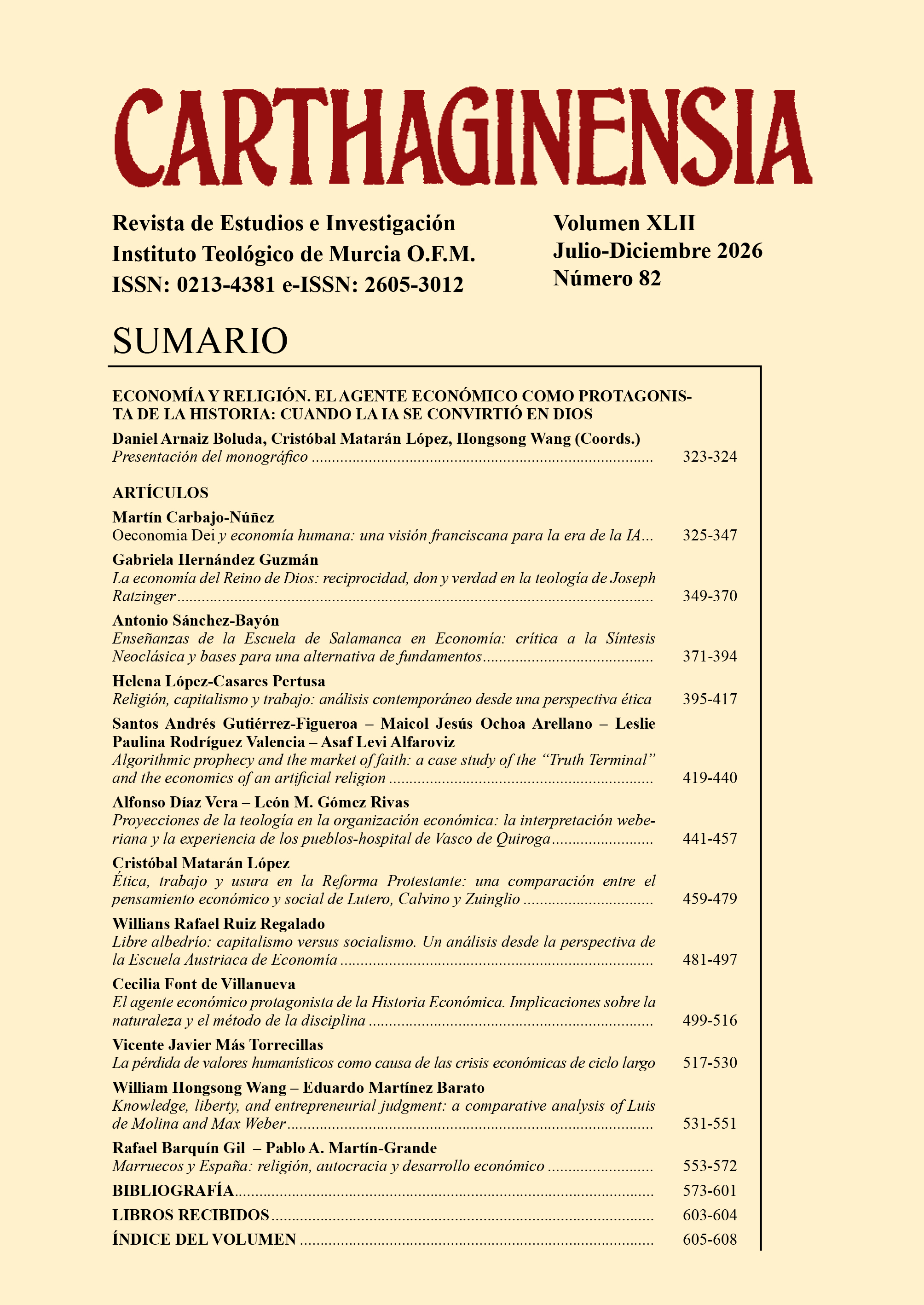
The economic agent as protagonist of Economic History: Implications for the nature and method of the discipline
Article Sidebar
Main Article Content
Abstract
Economic History is a relatively young discipline that tries to analyze economic events that took place in the past. Throughout its existence the use of new methodologies has motivated the reduction of its field of study.The present study aims to analyze, in the light of Economic Theory, the nature of the discipline in order to show how a more complete conception of its nature allows to conceive its field of study in a more global way and thereby expand its explanatory capacity. This analysis highlights the anthropological, epistemological and ethical implications that derive from considering it in this way.
In short, it is a question of fleeing from a scientific method that imposes a limit on the possibilities of knowledge that Economic History entails. Correctly defining the formal and material object of the discipline is fundamental to determine the most appropriate scientific method to achieve this end.
Downloads
Global Statistics ℹ️
|
663
Views
|
130
Downloads
|
|
793
Total
|
|
Article Details

This work is licensed under a Creative Commons Attribution 3.0 Unported License.
The works published in this journal are subject to the following terms:
1. Carthaginensia retains the patrimonial rights (copyright) of the published works, and favors and allows the reuse of the same under the license of use indicated in the following point.
2. The works are published in the electronic edition of the journal under a Creative Commons By (CC By) License https://creativecommons.org/licenses/by/3.0/es/. They may be copied, used, disseminated, transmitted and publicly exhibited, provided that: i) the authorship and the original source of publication (journal, publisher and URL of the work) are cited; ii) they are not used for commercial purposes; iii) the existence and specifications of this license of use are mentioned.




References
Allen, Robert C. 2011. Global Economic History: A Very Short Introduction. Vol. 282. Oxford: Oxford University Press.
Benedicto XVI. 2006. “Discurso en la Universidad de Ratisbona.”
Benedicto XVI. 2008. “Discurso en el encuentro con la Universidad de Roma ‘La Sapienza.’”
Concilio Vaticano II. 1962. Constitución Pastoral Gaudium et Spes.
Crafts, Nicholas. 2002. The human development index, 1870–1999: Some revised estimates. European Review of Economic History, 6(3), 395–405. DOI: https://doi.org/10.1017/S1361491602000187
Demeulemeester, Jean-Luc, y Claude Diebolt. 2007. “How Much Could Economics Gain from History: The Contribution of Cliometrics.” Cliometrica 1 (1): 7–17. DOI: https://doi.org/10.1007/s11698-006-0002-0
Diebolt, Claude, y Michael Haupert. 2018. “We Are Ninjas: How Economic History Has Infiltrated Economics.” Association Française de Cliométrie (AFC) Working Papers, no. 4.
Fogel, Robert W., y G. R. Elton. 1983. Which Road to the Past?: Two Views of History. New Haven: Yale University Press.
Gallardo-Albarrán, Daniel. 2019. Missed opportunities? Human welfare in Western Europe, 1913–1950. Explorations in Economic History, 72, 57–73. DOI: https://doi.org/10.1016/j.eeh.2018.11.004
Gallardo-Albarrán, Daniel y de Jong, Herman. 2021. Optimism or pessimism? A composite view on English living standards during the Industrial Revolution. European Review of Economic History, 25(1), 1–19. DOI: https://doi.org/10.1093/ereh/heaa002
Jones, Geoffrey. 2017. Profits and sustainability: A history of green entrepreneurship. Oxford University Press.
Jones, Geoffrey. 2023. Deeply responsible business: A global history of values-driven leadership. Harvard University Press. DOI: https://doi.org/10.4159/9780674292994
Jones, Geoffrey y Khanna, Tarun. 2022. Leadership to last: How great leaders leave legacies behind. Penguin Random House India.
Marx, Karl, y Friedrich Engels. 1848. El Manifiesto del Partido Comunista.
Margo, Robert A. 2021. “The Economic History of Economic History: The Evolution of a Field in Economics.” En The Handbook of Historical Economics, 3–16. Academic Press. DOI: https://doi.org/10.1016/B978-0-12-815874-6.00009-5
McCloskey, Deirdre. 1991. “The Prudent Peasant: New Findings on Open Fields.” The Journal of Economic History 51 (2): 343–55. http://www.jstor.org/stable/2122579. DOI: https://doi.org/10.1017/S0022050700038985
North, Douglass C. 1976. “The Place of Economic History in the Discipline of Economics.” Economic Inquiry 14 (4): 461–65. DOI: https://doi.org/10.1111/j.1465-7295.1976.tb00436.x
North, Douglass C. 1978. “Structure and Performance: The Task of Economic History.” Journal of Economic Literature 16 (3): 963–78.
Pontificio Consejo “Justicia y Paz.” 2004. Compendio de Doctrina Social de la Iglesia. DOI: https://doi.org/10.36576/summa.29299
Prados de la Escosura, L. 2008. Inequality, poverty and the Kuznets curve in Spain, 1850–2000. European Review of Economic History, 12(3), 287–324. DOI: https://doi.org/10.1017/S1361491608002311
Prados de la Escosura, L. 2021. Augmented human development in the age of globalization. Economic History Review, 74(4), 946–975. DOI: https://doi.org/10.1111/ehr.13064
Ryckbosch, Wouter. 2016. Economic inequality and growth before the industrial revolution: The case of the Low Countries (fourteenth to nineteenth centuries). European Review of Economic History, 20(1), 1–22.
Robbins, Lionel. 1932. An Essay on the Nature and Significance of Economic Science.
Rodríguez Salazar, Óscar. 1997. “¿Qué Relaciones se Pueden Establecer entre Historia y Economía?” Historia Crítica, no. 14: 99–115. DOI: https://doi.org/10.7440/histcrit14.1997.06
Rubio de Urquía, Ramón. 2009. “¿Qué es la Teoría Económica?” Revista Portuguesa de Filosofía, 519–48.
Sánchez-Bayón, Antonio. 2024. Ortodoxia versus heterodoxia sobre la colonización del oeste estadounidense por empresas religiosas e ideológicas. Carthaginensia, 40(77), 117-156. DOI: https://doi.org/10.62217/carth.457
Schumpeter, Joseph A. 1947. “The Creative Response in Economic History.” The Journal of Economic History 7 (2): 149–59. DOI: https://doi.org/10.1017/S0022050700054279
Sen, Amartya. 1989. “Cooperation, Inequality, and the Family.” Population and Development Review 15: 61–76. DOI: https://doi.org/10.2307/2807922
Solow, Robert M. 1985. “Economic History and Economics.” The American Economic Review 75 (2): 328–31.
Suárez Fernández, Luis. 1976. Grandes Interpretaciones de la Historia.
Tedde de Lorca, Pedro. 1984. “La Historia Económica y los Economistas.” Papeles de Economía Española, no. 20: 362–81.
Tedde de Lorca, Pedro. 2009. Los Economistas y la Historia.
Temin, Peter. 1981. “The Future of the New Economic History.” The Journal of Interdisciplinary History 12 (2): 179–97. DOI: https://doi.org/10.2307/203023
Temin, Peter. 2014. “The Rise and Fall of Economic History at MIT.” History of Political Economy 46 (suppl_1): 337–50.
Tomás de Aquino. [1267–1273 (2001)]. Suma de Teología. Madrid: BAC.
Zamagni, Stefano. 2006. Heterogeneidad Motivacional y Comportamiento Económico. Madrid: UFV.