
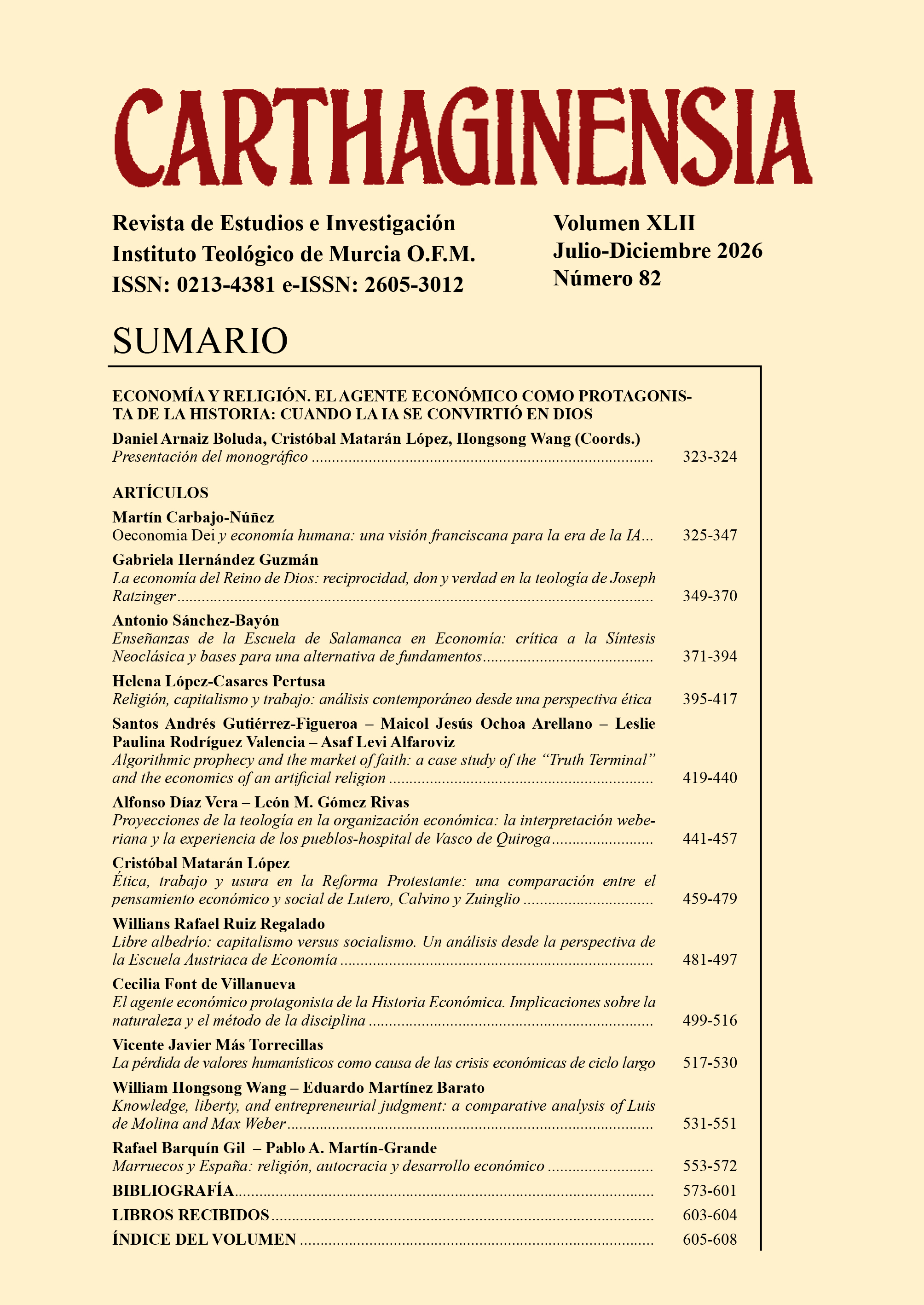
Ethics, Labor, and Usury in the Protestant Reformation: A Comparative Study of the Economic and Social Thought of Luther, Calvin, and Zwingli
Article Sidebar
Main Article Content
Abstract
This article analyzes the economic and social thought of the main Protestant Reformers of the sixteenth century. Although they did not develop a formal economic theory, their doctrines offered normative principles on labor, property, wealth, taxation, and the role of the State. From their respective traditions, Luther, Calvin, and Zwingli expressed a moral critique of profit, accumulation, and usurious practices, while defending the role of civil power in promoting the common good. In this context, Weber's hypothesis linking Protestantism with the rise of capitalism is critically revisited, showing that the Reformers articulated a moral economy rather than a justification of the market. Through the analysis of primary sources and recent scholarship, the article proposes a reinterpretation of the Protestant legacy as a theory of value rooted in Christian ethics and social justice.
Downloads
Global Statistics ℹ️
|
1850
Views
|
218
Downloads
|
|
2068
Total
|
|
Article Details

This work is licensed under a Creative Commons Attribution 3.0 Unported License.
The works published in this journal are subject to the following terms:
1. Carthaginensia retains the patrimonial rights (copyright) of the published works, and favors and allows the reuse of the same under the license of use indicated in the following point.
2. The works are published in the electronic edition of the journal under a Creative Commons By (CC By) License https://creativecommons.org/licenses/by/3.0/es/. They may be copied, used, disseminated, transmitted and publicly exhibited, provided that: i) the authorship and the original source of publication (journal, publisher and URL of the work) are cited; ii) they are not used for commercial purposes; iii) the existence and specifications of this license of use are mentioned.




References
Álvarez Palenzuela, Vicente Ángel. El cisma de Occidente. Madrid: RIALP, 1982.
Arenas Laorga, Carlos. «El sistema educación español: Un enfoque austriaco.» Editado por Unión Editorial. Procesos de Mercado. Revista Europea de Economía Política XII, nº 1 (2015): 83-118.
Biéler, André. El humanismo social de Calvino. Buenos Aires: Escaton, 1973.
Böhm-Bawerk, Eugen. Capital e interés. Madrid: Editorial Innisfree, [1884] 2015.
—. Teoría positiva del capital. Madrid: Ediciones Aosta, [1899] 1998.
Braudel, Fernand. Civilization and Capitalism, 15th–18th Century: The Structures of Everyday Life. Nueva York: Harper&Row, 1982.
Calvino, Juan. Institución de la religión cristiana. Vol. Vol. II. Madrid: Visor Libros, [1597] 2003.
—. Institución de la religión cristiana. Vol. Vol. I. Madrid: Visor Libros, [1597] 2003.
Cipolla, Carlo M. Las máquinas del tiempo y de la guerra. Estudios sobre la génesis del capitalismo. Barcelona: Crítica, 2017.
Coase, Ronald H. «The LightHouse in Economics.» Journal of Law and Economics XVII, nº 2 (1974): 357-376. DOI: https://doi.org/10.1086/466796
de Vries, Jan. The Economy of Europe in an Age of Crisis, 1600-1750. Cambridge: Cambridge University Press, 1976. DOI: https://doi.org/10.1017/CBO9781107049772
Eckermann, Johann Peter. Conversaciones con Goethe en los últimos años de su vida. Madrid: El Acantilado, [1828] 2005.
European Lutheran Commision on the Church and the Jewish People. «A Response to Dabru Emet.» Public Statement, Graz (Austria), 2003.
Ferguson, Niall. The Ascent of Money: A Financial History of the World. Nueva York: Penguin Press, 2008.
Figueroa Ibérico, Ángela María. «Las concepciones sobre educación y ciudadanía en las reformas de Lutero.» Publicaciones: Facultad de Educación y Humanidades del Campus de Melilla, nº 43 (2013): 29-43.
Flynn, Dennis, y Arturo Giráldez. «Born with a ‘Silver Spoon’: The Origin of World Trade in 1571.» Journal of World History 6, nº 2 (1995): 201-221. DOI: https://doi.org/10.4324/9781003554325-2
García-Alonso, Martha. La teología política de Calvino. Barcelona: Anthropos, 2008.
Gómez Rivas, León. «La educación universitaria americana y la escolástica salmantina. Pensamiento económico (virreinatos del Perú y Río de la Plata).» Cuadernos salmantinos de filosofía, nº 30 (2003): 427-437. DOI: https://doi.org/10.36576/summa.1197
Gomis, Joan. Calvino: Una vida por la Reforma. Barcelona: Planeta, 1993.
Grice-Hutchinson, Marjorie. The School of Salamanca. Readings in Spanish Monetary Theory. Oxford: Clarendon Press, 1952.
Grisar, Hartmann. Martín Lutero. Su vida y su obra. Madrid: Libería Salambó, 1934.
Hayek, F.A. «Normas y orden.» En Derecho, legislación y libertad, de F.A. Hayek, 25-179. Madrid: Unión Editorial, [1973] 2014.
Hernández-Fradejas, Fernando. «La Escuela de Salamanca como precursora de la economía moderna.» Procesos de Mercado. Revista Europea de Economía Política VIII, nº 2 (2011): 331-352. DOI: https://doi.org/10.52195/pm.v8i2.259
Huerta de Soto, Jesús. «Juan de Mariana y los escolásticos españoles.» Dendra médica. Revista de Humanidades XIII, nº 1 (2013): 32-45.
Iglesia Católica. Código de Derecho Canónico. 25 de enero de 1983.
http://www.vatican.va/archive/ESL0020/__P3G.HTM (último acceso: 30q de diciembre de 2020).
Jacobs, Joseph G. The Jewish Encyclopedia. New York: Isidore Singer, 1906.
Leoni, Bruno. La libertad y la ley. Madrid: Unión Editorial, [1961] 2011.
Lutero, Martín. A la nobleza de la nación alemana. Vol. Escritos de Reforma, de Obras reunidas, de Martín Lutero, 168. Madrid: Editorial Trotta, [1520] 2018.
—. A la nobleza de la nación alemana sobre el mejoramiento de los Estados cristianos. México, D.F.: Universidad Nacional Autónoma de México, [1520] 2003.
—. Conversaciones de sobremesa. CreateSpace Independent Publishing Platform, [1934] 2016.
Lutero, Martín. Juicio sobre los votos monásticos. Vol. Escritos de Reforma, de Obras reunidas, de Martín Lutero, 480. Madrid: Editorial La Trotta, [1521] 2018.
Lutero, Martín. Preludio sobre la cautividad babilónica de la Iglesia. Vol. Escritos de Reforma, de Obras reunidas, de Martín Lutero, 237-8. Madrid, California: Editorial La Trotta, [1520] 2018.
—. Sobre los judíos y sus mentiras. Valencia: NoBooks Editorial, [1543] 2011.
Lutero, Martín. Tratado sobre la libertad cristiana. Vol. Escritos de Reforma, de Obras reunidas, de Martín Lutero, 363. Madrid: Editorial La Trotta, 2018.
Manacorda, Mario Alighiero. Historia de la educación. Traducido por Miguel Martí. Vol. Vol II: De 1500 a nuestros días. Tres Cantos, Comunidad de Madrid: Siglo XXI, 1987.
Martínez Meseguer, César. La teoría evolutiva de las instituciones. La perspectiva austriaca. Madrid: Unión Editorial, [2006] 2012.
Matarán, Cristóbal. «Educación privada y gratuita.» Congreso de Economía Austriaca. Madrid: Instituto Juan de Mariana, 2020. 98-117.
Matarán, Cristóbal. «Raíces de la teoría de la explotación y la crítica austriaca: de Sismondi a Böhm-Bawerk.» Iberian Journal of the History of Economic Thought 9, nº 1 (2022): 25-41. DOI: https://doi.org/10.5209/ijhe.76497
Menger, Carl. El dinero. Madrid: Unión Editorial, [1892] 2013.
Mosler, Warren. Soft Currency Economics. Ginebra: CreateSpace Independent Publishing Platform, 2013.
Perrin, John William. The History of Compulsory Education in New England. Whitefish, Montana: Kessinger Publishing, 1896 [2015].
Ravasi, Gianfranco. «Lutero, al antisemita.» Vida Nueva, nº 3021 (2017): 50.
Rössner, Philipp Robinson. «Martin Luther and the making of the modern economic.» International Review of Economics 66 (2018): 233-248. DOI: https://doi.org/10.1007/s12232-018-0307-x
Rothbard, Murray N. Educación: libre y obligatoria. Auburn, Alabama: Instituto Mises, [1979] 2019.
Samuelson, Paul. «The Pure Theory of Public Expenditure.» Review of Economics and Statistics (MIT Press) XXXVI, nº 4 (1954): 387-389. DOI: https://doi.org/10.2307/1925895
Souza, J.A. «O Protestantismo em Marx.» Reforma Protestante, Capitalismo e Marxismo: Estudos Interdisciplinares (Universidade Presbiteriana Mackenzie), 2020: 59-71.
Stephens, W.P. The Theology Of Huldrych Zwingli. Oxford: Clarendon Press, 1986.
Suárez Litvin, Roldan Tomasz. «El sentido histórico del proyecto educativo de Lutero.» Editado por Centro de Investigaciones en Sistemología Interpretativa. Frónesis X, nº 23 (2003): 23.
Wallerstein, Immanuel. The Modern World-System: Capitalist Agriculture and the Origins of the European World-Economy in the Sixteenth Century. Nueva York: Academic Press, 1974.
Weber, Max. La ética protestante y el espíritu del capitalismo. Madrid: Alianza, [1905] 2001.
Zuinglio, Ulrico. «Breve instrucción cristiana.» En Antología, de Ulrico Zuinglio, 119-166. Barcelona: Producciones Editoriales del Nordeste, [1545] 1973.
Zuinglio, Ulrico. «Comentario sobre la verdadera y falsa religión.» En Antología, de Ulrico Zuinglio, 167-206. Barcelona: Producciones Editoriales del Nordeste, [1545] 1973.
Zuinglio, Ulrico. «Consejero de reyes.» En Antología, de Ulrico Zuinglio, 215-226. Barcelona: Producciones Editoriales del Nordeste, [1545] 1973.
Zuinglio, Ulrico. «El coloquio de Marburgo.» En Antología, de Ulrico Zuinglio, 207-214. Barcelona: Producciones Editoriales del Nordeste, [1545] 1973.
Zuinglio, Ulrico. «La justicia de Dios y la justicia humana.» En Antología, de Ulrico Zuinglio, 98-106. Barcelona: Producciones Editoriales del Nordeste, [1545] 1973.
Zuinglio, Ulrico. «Las 67 conclusiones.» En Antología, de Ulrico Zuinglio, 39-52. Barcelona: Producciones Editoriales del Nordeste, [1545] 1973.
Zuinglio, Ulrico. «Sobre el pastor.» En Antología, de Ulrico Zuinglio, 92-97. Barcelona: Producciones Editoriales del Nordeste, [1545] 1973.
Zuinglio, Ulrico. «Sobre la claridad y verdad de la palabra de Dios.» En Antología, de Ulrico Zuinglio, 79-81. Barcelona: Producciones Editoriales del Nordeste, [1545] 1973.