
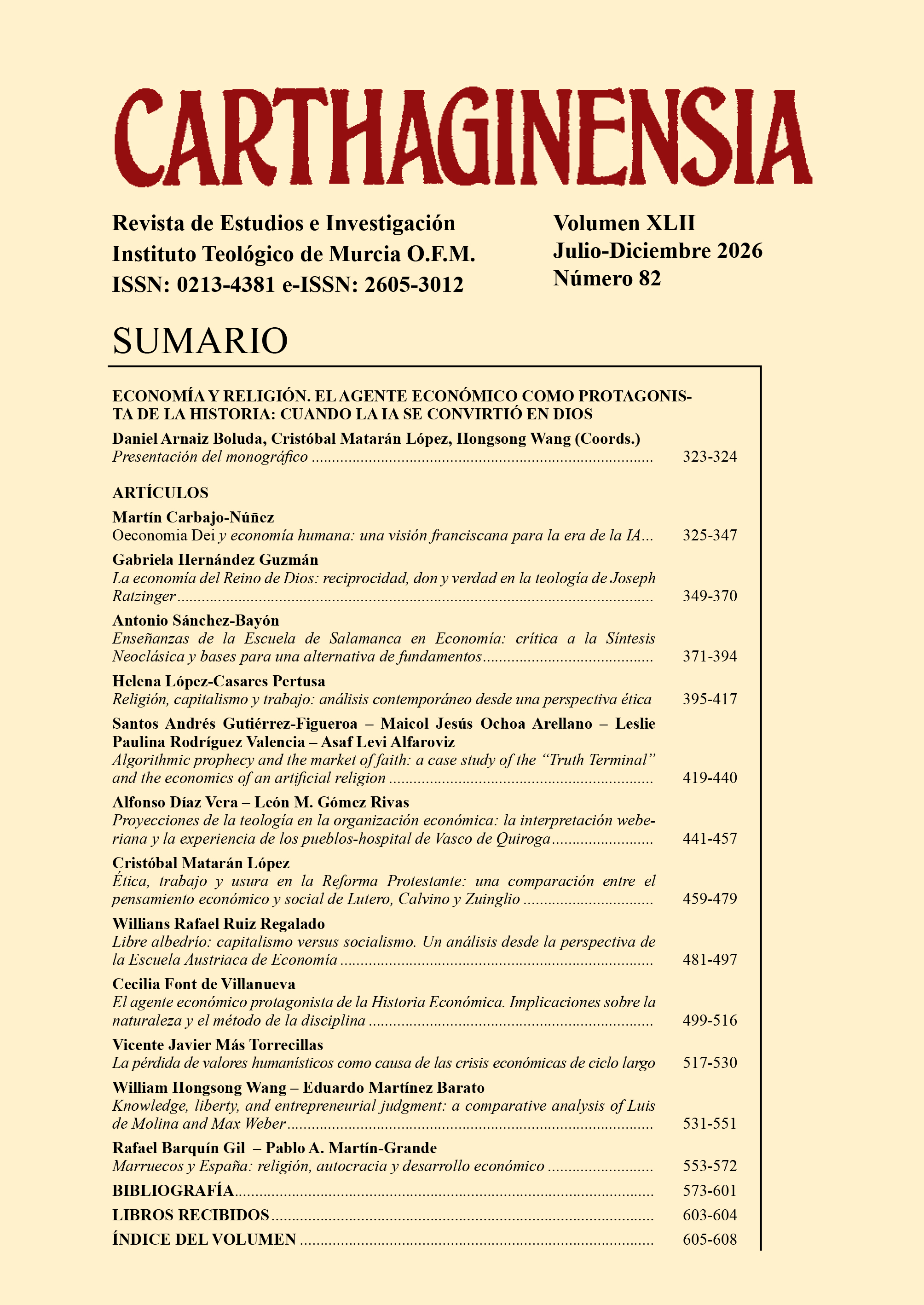
Morocco and Spain: Two Histories That Should Not Be So Different
Article Sidebar
Main Article Content
Abstract
This paper examines the reasons for the significant differences in the economic development of Spain and Morocco prior to colonisation. Despite sharing many similarities in terms of factors commonly considered to be determinants of economic progress, such as geography, Roman philosophical and legal tradition, urbanisation and commercial dedication, the two nations experienced significantly different levels of development. Religion is, of course, the main differentiating factor and therefore the main 'suspect' in explaining Morocco's backwardness. However, it is difficult to identify the specific aspects that constituted an economic disadvantage compared to Christianity. In fact, both negative and positive aspects can be identified. Our thesis is that, while Islam was indeed an obstacle, it was an indirect one: the legitimisation of autocracy and, therefore, paradoxically, an inability to create a secure environment for business.
Downloads
Global Statistics ℹ️
|
773
Views
|
190
Downloads
|
|
963
Total
|
|
Article Details

This work is licensed under a Creative Commons Attribution 3.0 Unported License.
The works published in this journal are subject to the following terms:
1. Carthaginensia retains the patrimonial rights (copyright) of the published works, and favors and allows the reuse of the same under the license of use indicated in the following point.
2. The works are published in the electronic edition of the journal under a Creative Commons By (CC By) License https://creativecommons.org/licenses/by/3.0/es/. They may be copied, used, disseminated, transmitted and publicly exhibited, provided that: i) the authorship and the original source of publication (journal, publisher and URL of the work) are cited; ii) they are not used for commercial purposes; iii) the existence and specifications of this license of use are mentioned.




References
Acemoglu, Daron, y James A. Robinson. Why nations fail: The origins of Power, Prosperity and Poverty. Nueva York: Crown Publishers, 2012.
Alvarado, David. Rif: De Abdelkrim a los indignados de Alhucemas. Madrid: Catarata, 2017.
Armstrong, Karen. Los orígenes del fundamentalismo. Madrid: Tusquets, 2004.
Aziza, Mimoun. España y el Rif. Miradas cruzadas. Madrid: Editorial Diwan Mayrit, 2023.
Barquín, Rafael. El Islam (622-1800). Un ensayo desde la Historia Económica. Madrid: Editorial UNED, 2012.
Barquín, Rafael. Escapando del Eurocentrismo. Una historia no-europea del mundo en la Edad Moderna. Santander: Editorial de la Universidad de Cantabria, 2020. https://doi.org/10.22429/Euc2021.003 DOI: https://doi.org/10.22429/Euc2021.003
Elharti, Mehdi. Fundamental obstacles to modernization in precolonial Morocco: Geography, institutions and culture. Universidad de Granada, 2017. http://hdl.handle.net/10481/48472
Hoodbhoy, Pervez, El islam y la ciencia. Barcelona: Bellaterra, 1991.
Huntington, Samuel P. El choque de civilizaciones y la reconfiguración del orden mundial. Barcelona: Paidós, 1997.
Jiménez Muñoz, Francisco Javier. La usura. Evolución histórica y patología de los intereses. Madrid: Dykinson, 2010.
Kuran, Timur. The Long Divergence: How Islamic Law Held Back the Middle East. Princeton University Press, 2011. https://www.jstor.org/stable/j.ctt7t73p. DOI: https://doi.org/10.1515/9781400836017
Lewis, Bernard. Los árabes en la Historia. Madrid: Espasa Calpe, 2005.
Madariaga, María Rosa. Historia de Marruecos. Madrid: Catarata, 2017.
Martín-Grande, Pablo A. “La historia de la usura y de las teorías del interés desde la Antigüedad hasta los años previos a Adam Smith”. História e Economia 31(1) (2025): 44-60.
https://www.historiaeeconomia.pt/he/article/view/376
Martínez Meseguer, César. La Teoría Evolutiva de las Instituciones. Madrid: Unión Editorial, 2009.
North, Douglass C., y Robert Paul Thomas, The Rise of the Western World. Cambridge University Press, 2012. https://doi.org/10.1017/CBO9780511819438 DOI: https://doi.org/10.1017/CBO9780511819438
North, Douglass C., y Barry R. Weingast, “Constitutions and Commitment: The Evolution of Institutions Governing Public Choice in Seventeenth-Century England”, The Journal of Economic History, 49(4) (1989): 803-832. https://www.jstor.org/stable/2122739 DOI: https://doi.org/10.1017/S0022050700009451
Pomeranz, Kenneth. The great divergence: China, Europe, and the makin world economy. Princeton University Press, 2000. https://doi.org/10.2307/j.ctt7sv80 DOI: https://doi.org/10.1515/9781400823499
Prak, Maarten, y Jan Luiten van Zanden. Pioneros del capitalismo. Los países bajos 1000-1800. Barcelona: Pasado & Presente, 2024.
Raha Ahmed, Rachid (ed.). Imazighen del Magreb entre Occidente y Oriente. Granada: Rachid Raha Ahmed, 1994.
Rogan, Eugene. Los árabes: del Imperio Otomano a la actualidad. Barcelona: Editorial Crítica, 2010.
Segura i Mas, Antoni. El Magreb: del colonialismo al islamismo. Barcelona: Universidad de Barcelona, 1994.
Tahiri, Ahmed. Rif Al-Magrib y Al-Andalus. Organización del territorio en las dos orillas del Estrecho (Siglos VIII-XI). Granada: Fundación El Legado Andalusí, 2007.
Vercellin, Giorgio. Instituciones del mundo musulmán. Barcelona: Bellaterra, 2003.
Zanden, Jan Luiten van. The Long Road to the Industrial Revolution: The European Economy in a Global Perspective, 1000-1800. Leiden: Brill, 2009. https://brill.com/display/title/16726 DOI: https://doi.org/10.1163/ej.9789004175174.i-346.5