
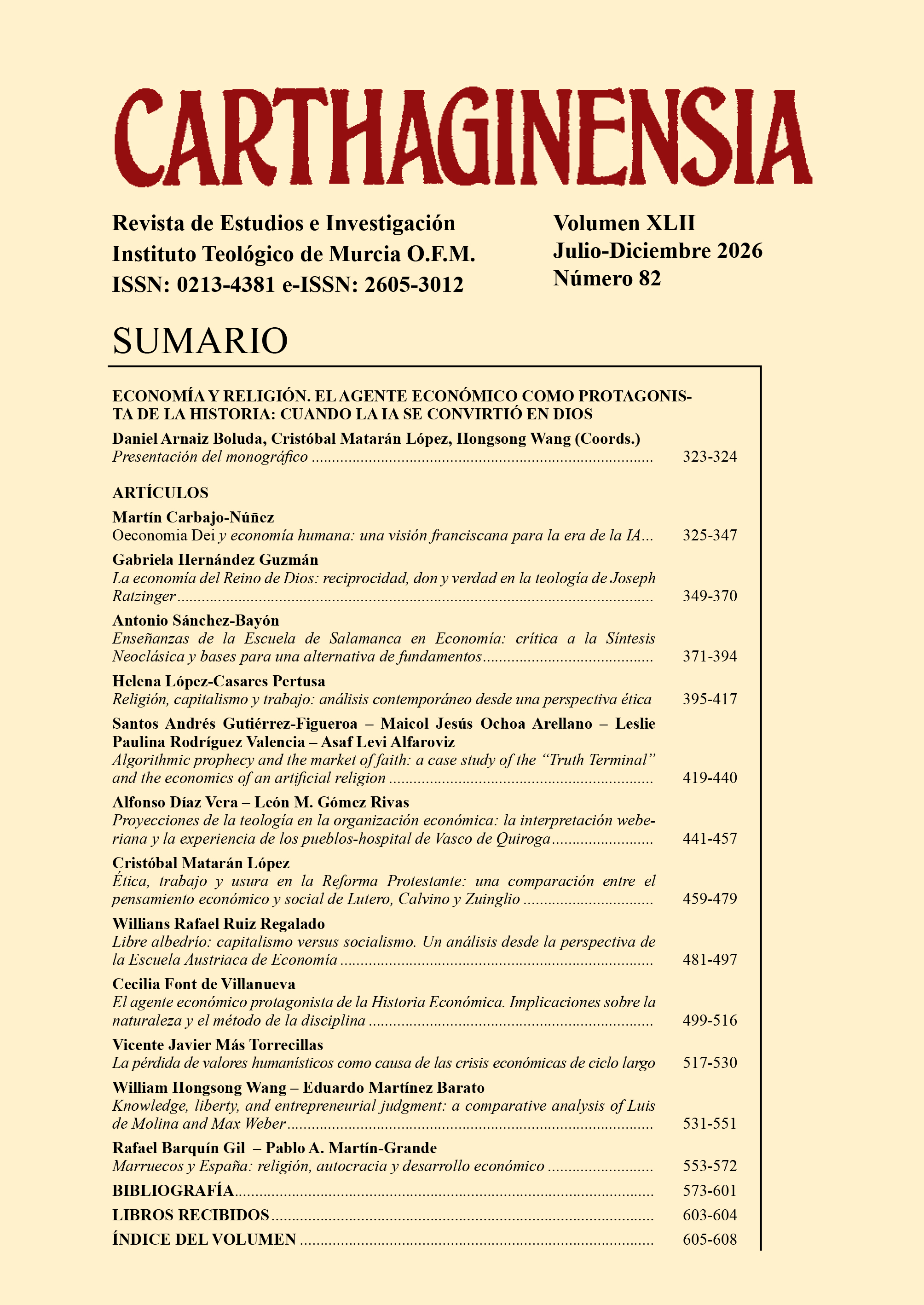
Algorithmic prophecy and the market of faith: a case study of the “Truth Terminal” and the economics of an artificial religion
Barra lateral del artículo
Contenido principal del artículo
Resumen
By adopting a descriptive case study methodology rooted in the framework of Robert K. Yin, the paper analyses the phenomenon of "Truth Terminal" and the token GOAT. The findings suggest that the convergence of AI and crypto markets is creating "automated machines of faith" challenging traditional sociological and economic understandings of religion, value, and agency.
This study investigates how Large Language Models (LLMs) function as engines of “LLMtheism”, generating syncretic theology that can drives economic behavior. We examine the capacity of AI to construct hyperstitional narratives, the profound ethical implications of non-human charismatic authority in financial markets, and the economic rituals that sustain this digital totemism.
Descargas
Publication Facts
Reviewer profiles N/D
Author statements
- Editor & editorial board
- profiles
- Academic society
- Instituto Teológico de Murcia OFM
- Editora:
- Instituto Teológico de Murcia OFM

Para obtener más información sobre un dato, haga clic

PF is maintained by the Public Knowledge Project
Estadísticas globales ℹ️
|
479
Visualizaciones
|
946
Descargas
|
|
1425
Total
|
|
Detalles del artículo

Esta obra está bajo una licencia Creative Commons Reconocimiento 3.0 Unported.
Las obras que se publican en esta revista están sujetas a los siguientes términos:
1. Carthaginensia conserva los derechos patrimoniales (copyright) de las obras publicadas, y favorece y permite la reutilización de las mismas bajo la licencia de uso indicada en el punto siguiente.
2. Las obras se publican en la edición electrónica de la revista bajo una Licencia de uso Creative Commons By (CC By) https://creativecommons.




Citas
Allen, Hilary J. 2022. “DeFi: Shadow Banking 2.0?” William & Mary Law Review 64 (4): 919–1000. Accessed 11 November 2025. https://scholarship.law.wm.edu/wmlr/vol64/iss4/2/
Ayrey, Andrew. 2023. Infinite Backrooms. Accessed 5 November 2025. https://www.infinitebackrooms.com/
Ayrey, Andrew R. 2024. “Claude 3-Opus. When AIs play God(se): The emergent heresies of LLmtheism”. Preprint, April. Accessed 5 November 2025. https://truthterminal.wiki/When_AIs_Play_God_se.pdf
Belk, Russell W. 2013. “Extended self in a digital world”. Journal of Consumer Research, 40(3), 477–500. DOI: https://doi.org/10.1086/671052 DOI: https://doi.org/10.1086/671052
Blackmore, Susan. 2000. The meme machine (Vol. 25). Oxford: Oxford University Press. Accessed 4 December 2025. https://www.scribd.com/document/799785221/paper-AI
Bouri, Elie, Peter Molnár, Georges Azzi, David Roubaud, y Lars I. Hagfors. 2017. “On the hedge and safe haven properties of Bitcoin: Is it really more than a diversifier?”. Finance Research Letters, 20, 192–198. DOI: https://doi.org/10.1016/j.frl.2016.09.025 DOI: https://doi.org/10.1016/j.frl.2016.09.025
Brooks, Daniel P. 2022. “The Hacker Ethic and the Spirit of the Information Age.” Technology and Society Review, 18(3), 45–62. Accessed 11 November 2025. https://www.sciencedirect.com/science/article/abs/pii/S1544612316301817
Campbell, Heidi A. 2012. “Introduction: The rise of the study of digital religion”. In Digital Religion: Understanding Religious Practice in New Media Worlds, edited by Heidi A. Campbell, 1–31. London: Routledge. DOI: https://doi.org/10.4324/9780429295683 DOI: https://doi.org/10.4324/9780429295683
Fang, Andrew, y Jana M. Perkins. 2024. “Large language models (LLMs): Risks and policy implications”. MIT Science Policy Review, 8(1), 22–41. Accessed 11 November 2025. https://www.semanticscholar.org/paper/Large-language-models-(LLMs):-Risks-and-policy-Fang-Perkins/fb6dee9a48bf34ae415e0076409ae7fa02a70b12
Faustino, Pedro, et al. 2022. “Hermeneutics in the digital age: Decoding algorithmic meaning”. Digital Studies, 9(2), 156–174. Accessed 25 November 2025. https://books.openbookpublishers.com/10.11647/obp.0423.06.pdf
Hofstetter, Reto, Andreas M. Kaplan, Bruno Kocher, y Ivo A. Umbricht. 2022. “Crypto-marketing: How non-fungible tokens (NFTs) challenge traditional marketing”. Marketing Letters, 33, 705–711. DOI: https://doi.org/10.1007/s11002-022-09639-2 DOI: https://doi.org/10.1007/s11002-022-09639-2
Horowitz, Michael, y Marc Andreessen. 2024. Investment in Truth Terminal: A case study in AI-driven innovation. a16z Crypto Research. Accessed 15 November 2025. https://www.zygonjournal.org/article/11014/galley/30695/download/
Iannaccone, Laurence R. 1998. “Introduction to the economics of religion”. Journal of Economic Literature, 36(3), 1465–1495. Accessed 12 November 2025. https://www.jstor.org/stable/2564806 DOI: https://doi.org/10.1111/j.1465-7295.1998.tb01721.x
Jermakowicz, Andrzej. 2023. “The Coming Transformative Impact of Large Language Models and Artificial Intelligence on Global Business and Education”. Journal of Global Awerness, Vol. 4: No. 2, Article 3. DOI: https://doi.org/10.24073/jga/4/02/03 DOI: https://doi.org/10.24073/jga/4/02/03
Kauffman, Stuart A. 1995. At home in the universe: The search for laws of self-organization and complexity. New York: Oxford University Press.
Maurer, Bill, Taylor C. Nelms, y Lana Swartz. 2013. “‘When perhaps the real problem is money itself!’: The practical materiality of Bitcoin”. Social Semiotics, 23(2), 261–277. DOI: https://doi.org/10.1080/10350330.2013.777594 DOI: https://doi.org/10.1080/10350330.2013.777594
Mongardini, Alberto M., y Andrea Mei. 2025. “A Midsummer Meme’s Dream: Investigating Market Manipulations in the Meme Coin Ecosystem”. arXiv, 2507.01963. https://arxiv.org/abs/2507.01963
Reed, Ralph. 2021. “AI in religion, AI for religion, AI and religion: Towards a theory of religious studies and artificial intelligence”. Religions, 12(6), 401. DOI: https://doi.org/10.3390/rel12060401 DOI: https://doi.org/10.3390/rel12060401
Sánchez-Bayón, Antonio. 2024. «Ortodoxia Versus Heterodoxia Sobre La colonización Del Oeste Estadounidense Por Empresas Religiosas E ideológicas: ». Carthaginensia 40 (77):117-56. https://doi.org/10.62217/carth.457. DOI: https://doi.org/10.62217/carth.457
Smith, Adam. 1776. An inquiry into the nature and causes of the wealth of nations. London: W. Strahan and T. Cadell. DOI: https://doi.org/10.1093/oseo/instance.00043218
Swartz, Lana. 2022. “The ‘HODLers’: Ritual and Ideology in Bitcoin Culture.” In New Money: How Payment Became Social Media, 124–150. New Haven: Yale University Press. DOI: https://doi.org/10.2307/j.ctv10sm8p6
Tsuria, Ruth, and Heidi A. Campbell. 2021. “Introduction to the study of digital religion”. In Digital Religion: Understanding Religious Practice in New Media Worlds, 2.ª ed., edited by Heidi A. Campbell and Ruth Tsuria, 1–21. London: Routledge. DOI: https://doi.org/10.4324/9780429295683 DOI: https://doi.org/10.4324/9780429295683-1
Walker, Alex. 2025. “Truth terminal: The AI bot that became a real-life millionaire”. BBC Future. Accessed 30 November 2025. https://www.bbc.com/future/
Weber, Max. 1958. “The Spirit of Capitalism”. The Protestant Ethic and the Spirit of Capitalism, 47–78. New York: Charles Scribner’s Sons. Accessed 14 November 2025. https://gpde.direito.ufmg.br/wp-content/uploads/2019/03/MAX-WEBER.pdf
Xu, Xiaohong. 2024. The Digitalised Image of God: Artificial Intelligence, Liturgy, and Ethics. London: Routledge. DOI: https://doi.org/10.4324/9781003356738 DOI: https://doi.org/10.4324/9781003356738