
Rupestrian Cavities, laurae in the province Carthaginensis of Hispania in the Late Antiquity: Les Covetes dels Moros (Bocairent, Valencia).
Article Sidebar
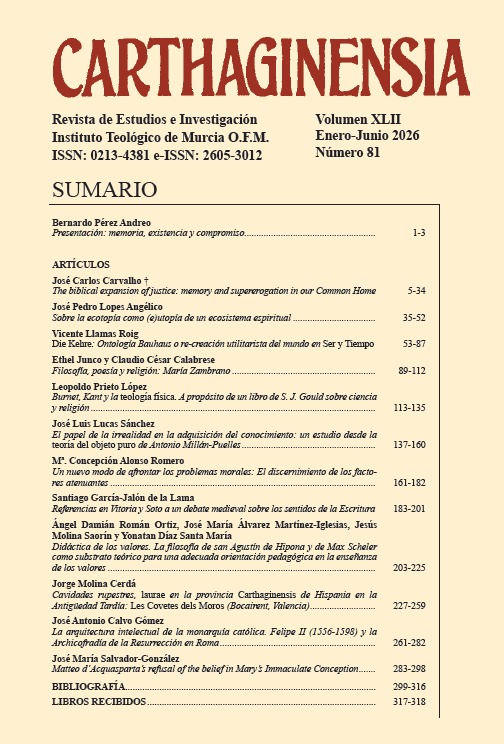
Main Article Content
Abstract
The rupestrian phenomenon occurs in the whole early christian orb, covering a wide geographic variety which ranges from the deserts of Syria, Lebanon, Palestine and Egypt up to Ethiopia. As well as the mountainous regions of Anatolia, Armenia, Greece, balkan, central, danubian and mediterranean Europe. The rupestrian monasteries and hermitages, with a chronology which goes from the third century up to now, since there’s loads of sanctuaries in caves and active monasteries which were founded in the Late Antiquity and the Middle Age. The cavities are situated in a village called Bocairent in the province of Valencia, the ancient Carthaginensis of the Roman Empire and later from the Visigothic kingdom. It is a monastery with lauras (windows) similar to those in places like the great palestinian Laura, already in the fifth century, the lauras near Jerusalem.
Downloads
Publication Facts
Reviewer profiles N/A
Author statements
- Editor & editorial board
- profiles
- Academic society
- Instituto Teológico de Murcia OFM
- Publisher
- Instituto Teológico de Murcia OFM

To learn about these publication facts, click 
PF is maintained by the Public Knowledge Project
Global Statistics ℹ️
|
979
Views
|
317
Downloads
|
|
1296
Total
|
|
Article Details

This work is licensed under a Creative Commons Attribution 3.0 Unported License.
The works published in this journal are subject to the following terms:
1. Carthaginensia retains the patrimonial rights (copyright) of the published works, and favors and allows the reuse of the same under the license of use indicated in the following point.
2. The works are published in the electronic edition of the journal under a Creative Commons By (CC By) License https://creativecommons.org/licenses/by/3.0/es/. They may be copied, used, disseminated, transmitted and publicly exhibited, provided that: i) the authorship and the original source of publication (journal, publisher and URL of the work) are cited; ii) they are not used for commercial purposes; iii) the existence and specifications of this license of use are mentioned.




References
Azcarate Garai-Olaun, A. «Consideraciones de carácter metodológico sobre el estudio de los complejos rupestres Alaveses». Actas del 1er Encuentro Nacional de Estudio de Cavidades Artificiales, Paterna (Valencia) (1996): 137-158.
Bakhtadze, N. «New considerations on the architectural structure of the Vardzia rock-cut ensemble and peculiarities of the ongoing monastic life». Proceedings of International Congress of Speleology in Artificial Cavities. Hypogea Dobrich-Bulgaria, 20-25 May. Eds. Alexey Zhalov, Vanyo Gyrorev, Meter Delchev (2019): 131-138.
Bakhtadze, N., Gabekhadze, B. y Mamiashvili, V. «Typological and Chronological Problems of David-Gareji (Georgia) Cave Churches Against the Background of Cappadocian Rock-cut Momuments». Proceedings of International Congress of Speleology in Artificial Cavities. 10Eds. Mario Parise, Carla Galeazzi, Roberto Bixo, Ali Yamaç Hypogea Cappadocia, Turcky, march 06/, (2017): 395-403.
Bar, D. «Rural Monasticism as a key Element in the Christianization of Byzantine Palestine». Harvarda Theological Review 98(1) (2005): 49-65. DOI: https://doi.org/10.1017/S0017816005000854
Bixio, A., Bixio, R. y De Pascale, A. «The rock-cut shelters identified at the beginning of the 20Th century by Guillaume de Jerphanion in Göreme (Cappadocia-Turkey): some new reflections». Speleology and Spelestology. Proceedings of the IX International scientific conference. Naberznye Chelny, (2018): 133-145.
Benedito, V. y Fornes, A. «Convent-Monestir Rupestre Agustí de Els Sants Reis». Revista de Festes de Sant Agustí, Bocairent (2007): 94-97.
Bertrand, M. Las cuevas de Guadix: Origenes y Evolución. Cuevas. Encuentro sobre el patrimonio trogodítico Beas de Gauadix, (2006).
Bobokhyan, A. y Davtyan, S. «Common Traits of Artificial Caves and Rock-cut Constructions in Ancient Armenia». Cappadocia Hypogea. Internationa Congress of Speleology in Artificial Cavities. Eds.Mario Parise, Carla Galeazzi, Roberto Bixio, Ali Yamaç in Proceedings of International Congres of Speleology in Artificial Cavities, Cappadocia, Turkey, March 06/10 (2017): 327-336.
Casnati, G. «Europa Nostra and EIBI missin in David Gareji monasterios and hermitages (Georgia)». Technical recomendations and some input. International conferencia David Gareji. Multidisciplinary Study an Development Strategy, Proceedings Tblisi, (2020): 16-25.
Fornes Jiménez, A. «Estudio de los conjuntos de Covetes de Bocairent, Ontinyent y Alfafara». Actas del 1er Encuentro Nacional de Estudio de Cavidades Artificiales, Paterna (Valencia) (1996): 90-114.
Galeazzi, C. y Germani, C. «The rock-cut settlement of Karlik (Central Turkey) Speleological investigations». Proceedings of International Congress of Speleology in Artificial Caves. Hypogea Cappadocia, March 6/8, (2017): 282-289.
González Blanco, A., Espinosa Ruiz, U. y Sáenz Gonzáles, J.M. «La población de la Rioja durante los siglos oscuros (IV-IX)». Berceo XCVI (1979): 81-111.
Gunko, A., Stepkin, V. y Kondratyeva, S. «Caves temples in the Don region, Russia and Ukraine». Eds. Mario Parise, Carla Gaeazzi, Roberto Bixio, Ali Yamac. Proceedings of International Congress of Speleology in Artificial Caves. Hypogea Cappadocia, Turkey 6/10 March. (2017): 468-474.
Kalas, V., 2009. «Sacred Boundaries and Protective Borders: Outlying Chapels of Middle Byzantine Settlements in Cappadocia». Eds. Charles Gates, Jacques Morin and Thomas Zimmermann. Sacred Landscapes in Anatolia and Noighboring Regions. BAR International Series 2024. Oxoford, 2009, 79-91.
Molina Cerdá J. «El Poblamiento en cuevas el interior de la Comunidad Valenciana (Bocairent, Banyeres de Mariola, Beneixama y Alfafara)». “Mozárabes. Identidad y Continuidad de su Historia”. Antigüedad y Cristianismo XXVIII (2011): 489-592.
Molina Gómez, J. A. y Castillo Lozano, J. Ángel. «Los Prodigios y concepción del poder en el mundo visigodo. A propósito de las lanzas coloreadas de Eurico: Prodigies and conception of power in the Visigothic world. About Eurichus’s coloured spears», Carthaginensia, 74 (2022), pp. 467–489. doi: 10.62217/carth.447. DOI: https://doi.org/10.62217/carth.447
Molina Gómez, J.A. «El monacato cristiano en Siria. Introducción, problemas y propuestas». Antigüedad y Cristianismo XV (1998): 379-397.
Mordeglia, S. «The anthropogenic caves in Finalese (northern Italy) during historical age». Eds Mario Parise, Carla Galeazzi, Roberto Bixio, Ali Yamac.Hipogea Proceedings of International Congress of Speleology in Artificial Cavities Cappadocia, Turkey March 6/8 (2017): 538-547.
Perrone, L. «Byzantine Monasticism in Gaza and in the Jusean Deser: A comparison of their spriritual traditions». Proche-Orient Chrétien 62 (2012): 6-22.
Rubin, R. «Greek and “Syrian” Anchorites in the Laura of ST. Firmin». Arman 15 (2003): 81-96. DOI: https://doi.org/10.2143/ARAM.15.0.504527
Reyes, A., García-Pulido, L.J., López, P.A., Brazille, V. y Guisado, L. «El santuario rupestre de San Torcuato (Guadix, Granada)». In. Jorge López Quiroga y Artemio Manuel Martínez Tejera (Eds). Archaeological studies on Late Antiquity and early medieval Europe (AD 400-1000) (Aslaeme Series) Porceedings 4. In convavis petrarum habitaverunt. El fenómeno rupestre en el Mediterráneo Medieval: De la investigación a la puesta en valor. BAR Internatinal Series 2591, Oxford, 2014. 321-339.
Sociedad espeleológica La Senyera, 1986. «Les Covetes dels Moros». Nuestra Espeleo, 16:30-35.
Vañó Silvestre, F. «El monumento nacional Les Casetes dels Moros». Revista de Festes de Sant Agustí (1985): 1-11.
Vázquez de Parga, L. La División de Wamba. Contribución al estudio de la historia y geografía eclesiásticas de la edad media Española. Consejo superior de investigaciones científicas. Instituto Jerónimo Zurita. Madrid, 1943.
Vives, J. Concilios Visigóticos e Hispano-Romanos. CSIC. Madrid,1963.
Yamaç, A. «Rock-cut Byzantine churches of Koramaz Valley (Kayseri, Turkey)». Jornal of Speleology in Artificial Cavities. Revista della Società Speleologica Italiana Comimisione Nazionale Cavità Artificiali Opera Ipogea1 (2021):51-68.
Zissu, B. y Kloner, A. «Underdround explorations at Horvat Qasra, Southern Judean Foothills, Israel». Proceedings of International Congress of Speleology in Artificial Cavities. Hypogea Dobrich-Bulgaria, 20-25 May. Eds. Alexey Zhalov, Vanyo Gyrorev, Meter Delchev, (2019): 125-130.