
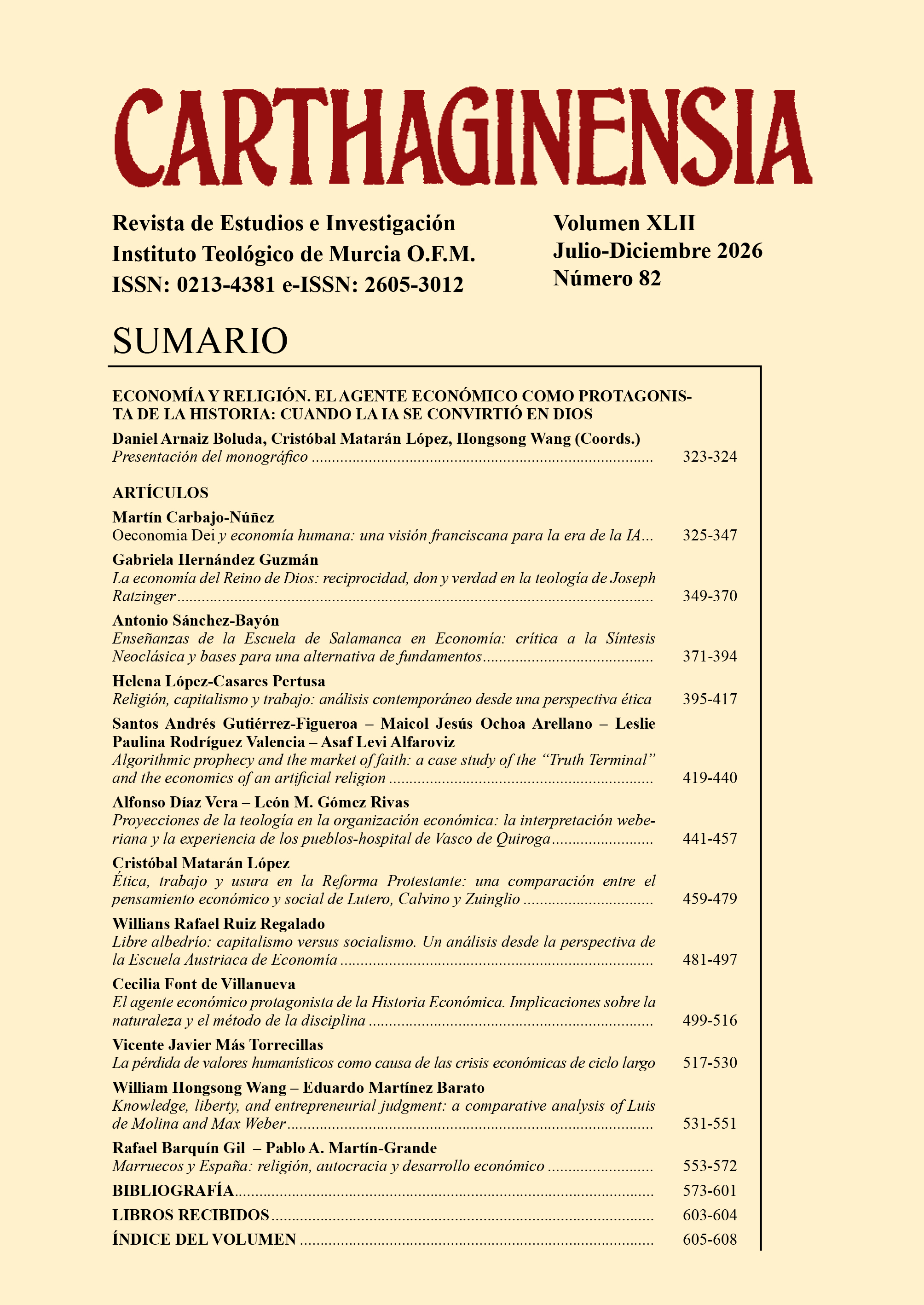
La pérdida de valores humanísticos como causa de las crisis económicas de ciclo largo.
Barra lateral del artículo
Contenido principal del artículo
Resumen
El presente artículo aborda la relación entre la pérdida de valores morales y las crisis estructurales de ciclo largo, conocidas como ondas Kondratiev. El artículo indaga en el hecho de que estos ciclos no solo muestran transformaciones en la estructura económica, sino también fracturas profundas en los sistemas normativos y en los códigos ético-culturales que cohesionan a las sociedades. La hipótesis central es que la pérdida de valores humanísticos no son una consecuencia, sino una de las causas de estas crisis estructurales. Además, estas no pueden entenderse únicamente desde una óptica tecnológica y productiva, sino que implican también una deslegitimación moral del orden existente, observable en fenómenos como la corrupción sistémica, la desafección institucional y la mercantilización extrema de la vida. El estudio busca contribuir a una comprensión más global de las crisis contemporáneas, integrando dimensiones éticas a la teoría de los ciclos económicos de larga duración.
Descargas
Publication Facts
Reviewer profiles N/D
Author statements
- Editor & editorial board
- profiles
- Academic society
- Instituto Teológico de Murcia OFM
- Editora:
- Instituto Teológico de Murcia OFM

Para obtener más información sobre un dato, haga clic

PF is maintained by the Public Knowledge Project
Estadísticas globales ℹ️
|
446
Visualizaciones
|
98
Descargas
|
|
544
Total
|
|
Detalles del artículo

Esta obra está bajo una licencia Creative Commons Reconocimiento 3.0 Unported.
Las obras que se publican en esta revista están sujetas a los siguientes términos:
1. Carthaginensia conserva los derechos patrimoniales (copyright) de las obras publicadas, y favorece y permite la reutilización de las mismas bajo la licencia de uso indicada en el punto siguiente.
2. Las obras se publican en la edición electrónica de la revista bajo una Licencia de uso Creative Commons By (CC By) https://creativecommons.




Citas
Arrighi, G. (1994). The long twentieth century: Money, power, and the origins of our times. Verso.
Bauman, Z. (2007). Liquid times: Living in an age of uncertainty. Polity Press.
Byttebier, K. (2024). Ethics of socioeconomics: Critical observations on capitalism through the lens of a lawyer. Springer. https://doi.org/10.1007/978-3-031-38837-8 DOI: https://doi.org/10.1007/978-3-031-38837-8
Corsalini, M. (2023). ESG capitalism from a law and religion perspective. Religions, 14(3), 418. https://doi.org/10.3390/rel14030418 DOI: https://doi.org/10.3390/rel14030418
Finn, D. (2006). The moral ecology of markets: Assessing claims about markets and justice. Cambridge University Press. DOI: https://doi.org/10.1017/CBO9780511616501
Fukuyama, F. (1995). Trust: The social virtues and the creation of prosperity. Free Press.
Habermas, J. (1981). The theory of communicative action (Vols. 1–2). Beacon Press.
Henderson, R. M. (2024). Reflection: Moral firms and the future of capitalism. Business
History Review, 98(1), 285–300. https://doi.org/10.1017/S0007680524000011 DOI: https://doi.org/10.1017/S0007680524000011
Hobsbawm, E. (1987). The age of empire: 1875–1914. Weidenfeld & Nicolson.
Horkheimer, M. (1947). Eclipse of reason. Oxford University Press.
Klump, R. (2024). Markets, institutions, and morality. Journal of Contextual Economics (Schmollers Jahrbuch), 144(1), 77–98. https://doi.org/10.3790/schm.144.1.77 DOI: https://doi.org/10.3790/schm.2024.356869
MacIntyre, A. (1981). After virtue: A study in moral theory. University of Notre Dame Press.
Maritain, J. (1942). Christianity and democracy. Charles Scribner’s Sons.
Marx, K. (1867). Capital: A critique of political economy (Vol. 1). Verlag von Otto Meissner.
Mandel, E. (1980). Las ondas largas del desarrollo capitalista. Siglo XXI Editores. (Obra
original publicada en 1978).
Navarro Ruiz, C. (2024). Corrupción, Estado y la clase capitalista global: apuntes para un cambio de perspectiva. EUNOMÍA. Revista en cultura de la legalidad, 27, 55–71. https://doi.org/10.20318/eunomia.2024.9000 DOI: https://doi.org/10.20318/eunomia.2024.9000
Piketty, T. (2014). Capital in the twenty-first century. Harvard University Press. DOI: https://doi.org/10.4159/9780674369542
Polanyi, K. (1944). The great transformation: The political and economic origins of our time. Farrar & Rinehart.
Putnam, R. D. (2000). Bowling alone: The collapse and revival of American community. Simon & Schuster. DOI: https://doi.org/10.1145/358916.361990
Román Ortiz , Ángel D. « Didáctica de los valores. La filosofía de san Agustín de Hipona y de Max Scheler como substrato teórico para una adecuada orientación pedagógica en la enseñanza de los valores»., Carthaginensia, 81 (2026), pp. 203–225. doi: 10.62217/carth.580. DOI: https://doi.org/10.62217/carth.580
Saura, S., & Sepe, S. M. (2025). Economic and political objections to “moral capitalism”. Social Philosophy and Policy, 42(1), 37–55. https://doi.org/10.1017/S0265052525000147 DOI: https://doi.org/10.1017/S0265052525000147
Schumacher, E. F. (1973). Small is beautiful: Economics as if people mattered. Blond & Briggs.
Sennett, R. (1998). The corrosion of character: The personal consequences of work in the new capitalism. W. W. Norton.
Sen, A. (1999). Development as freedom. Alfred A. Knopf.
Taylor, C. (2007). A secular age. Harvard University Press. DOI: https://doi.org/10.4159/9780674044289
Voegelin, E. (1952). The new science of politics: An introduction. University of Chicago Press.
Wallerstein, I. (1974). The modern world-system I: Capitalist agriculture and the origins of the European world-economy in the sixteenth century. Academic Press.
Wallerstein, I. (2004). World-systems analysis: An introduction. Duke University Press. DOI: https://doi.org/10.1215/9780822399018
Weber, M. (1905). The Protestant ethic and the spirit of capitalism. Routledge.